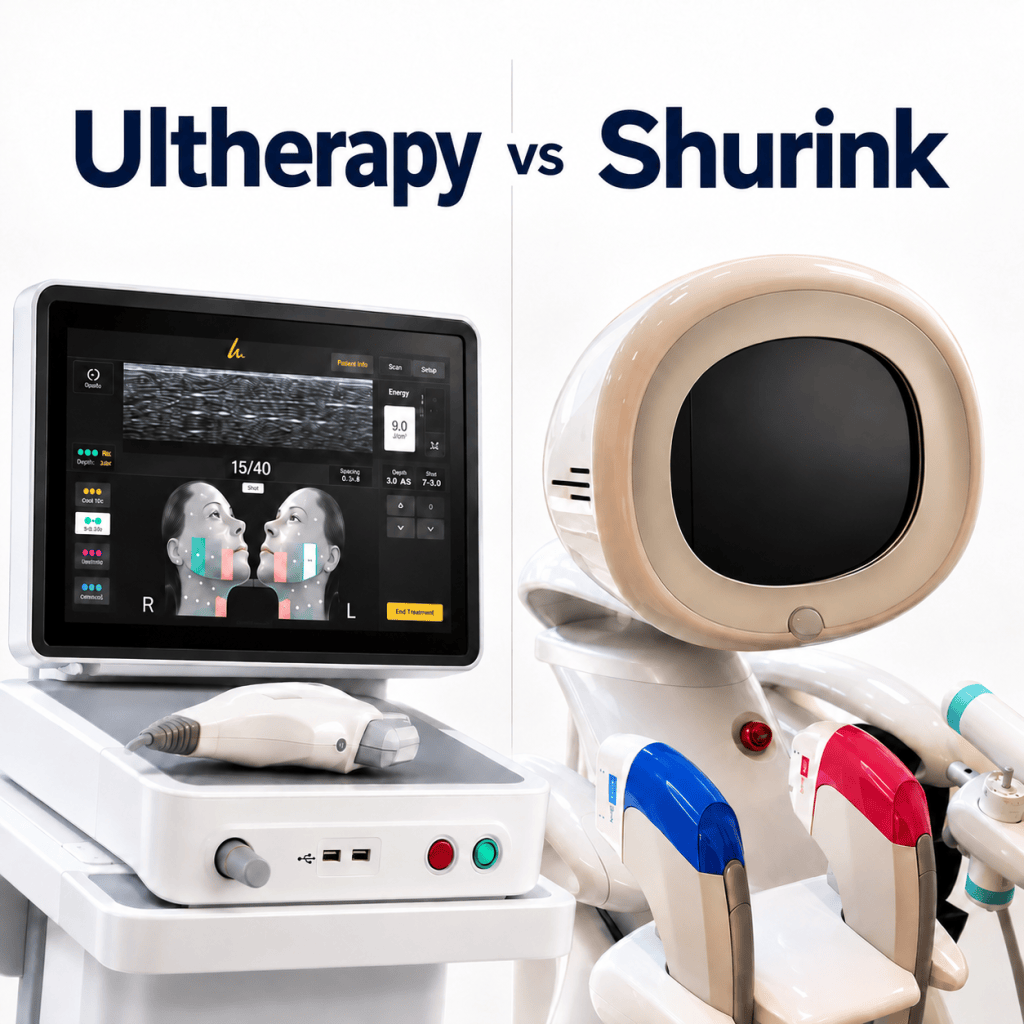
A DOCTOR’S GUIDE TO SKIN TREATMENTS IN KOREA
Hello, I’m Dr. Youro, a physician in Korea.
“Ultherapy or Shurink? Which should I choose, and could either make my cheeks look hollow?”
Both use focused ultrasound to treat skin laxity. Ultherapy’s defining difference is live ultrasound imaging during treatment. The treatment plan matters too: which tissue to target, where to concentrate coverage, and which areas to leave alone.
Here is how I explain the differences and plan treatment around the person’s face, rather than a standard full-face shot count.
In this guide
Device comparison / Tip depths / My treatment approach / Results / Downtime / Visiting Korea / FAQ
1. Ultherapy vs Shurink: what is the difference?
Shurink is the Korean name associated with Ultraformer III. Shurink Universe is marketed internationally as Ultraformer MPT. Ask for the exact model: “Shurink” does not always mean the same generation of equipment. Classys product names.
| Feature | Ultherapy / Ultherapy PRIME | Shurink / Shurink Universe |
|---|---|---|
| Method | MFU-V: focused ultrasound with imaging | Focused ultrasound (HIFU) |
| Live imaging | DeepSEE ultrasound imaging | No equivalent live DeepSEE imaging |
| Facial depths | 1.5, 3.0 and 4.5 mm | Model-dependent; MPT includes 1.5, 2.0, 3.0 and 4.5 mm |
| Planning | View tissue depth and check coupling during treatment | Select depth, energy and coverage from clinical assessment |
| Shot counts | No fixed shot-for-shot equivalent | Mode, cartridge and coverage also matter |
Both aim to improve laxity. The table is a technology comparison, not proof that every Ultherapy treatment outperforms every Shurink treatment. The exact device, settings, treatment area and operator all affect the result. Ulthera system instructions, Ultraformer MPT specifications.
2. What does HIFU do beneath the skin?
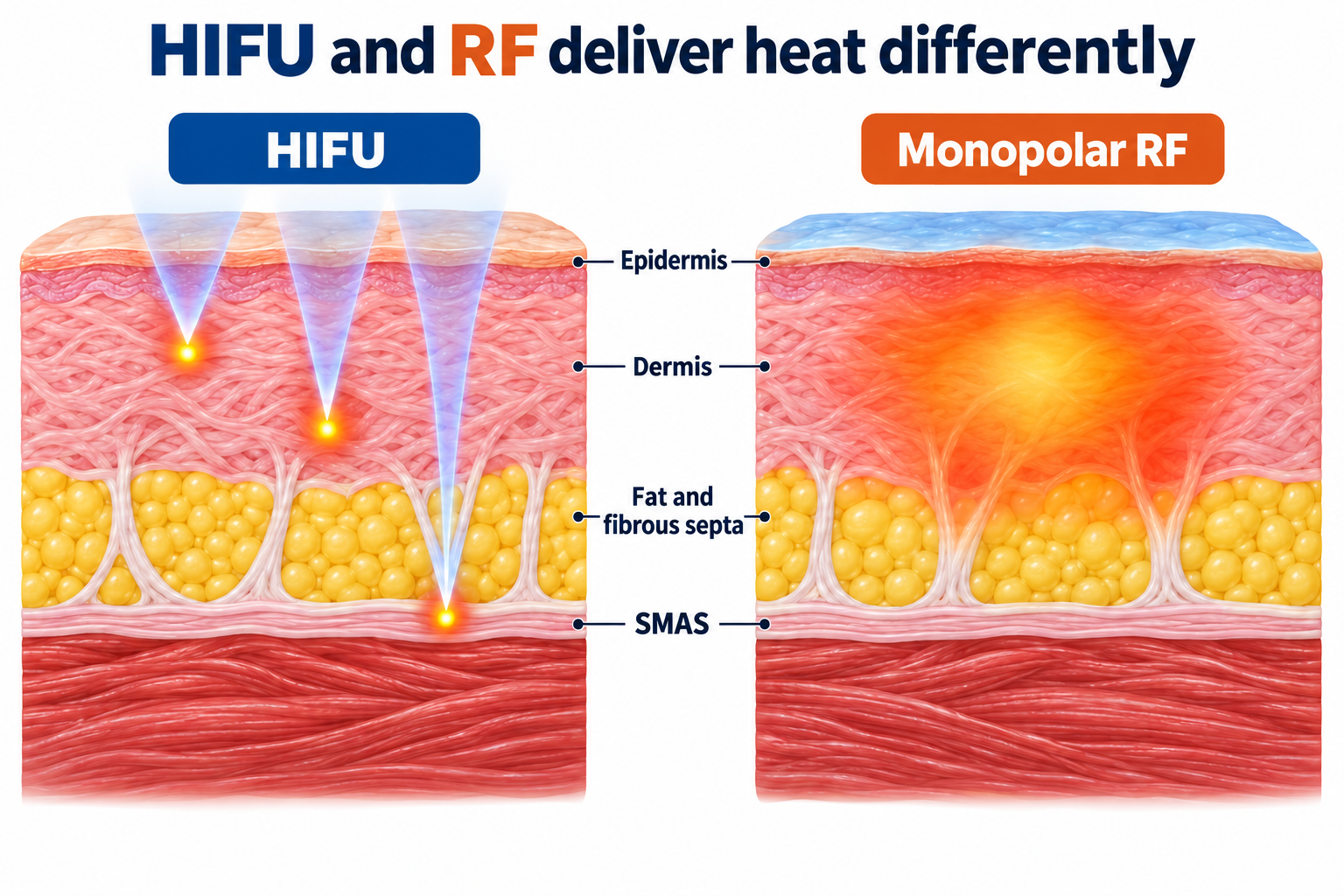
HIFU stands for high-intensity focused ultrasound. Ultrasound energy converges at a selected depth, creating small thermal treatment points. The tissue response includes collagen contraction and subsequent remodelling.
Radiofrequency (RF) devices, such as Thermage and Oligio, deliver heat differently. The distinction is the way energy reaches tissue, not simply “stronger” versus “weaker.”
For the wider comparison, see my guide to Ultherapy, Shurink, Thermage, Oligio and Onda.
3. What do 1.5, 2.0, 3.0 and 4.5 mm tips mean?
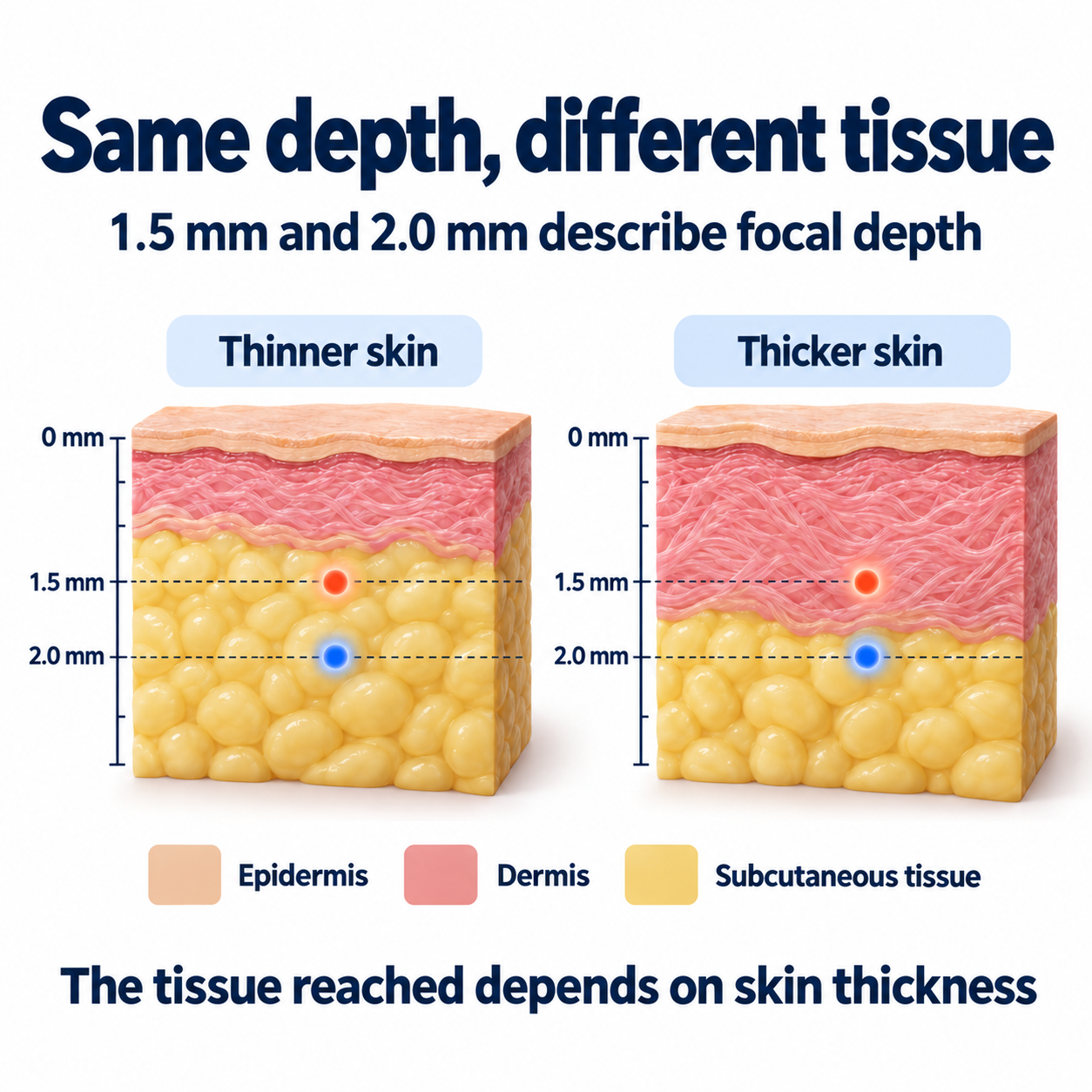
The number describes focal depth below the skin surface. It does not describe energy strength. A 4.5 mm tip is not simply a more powerful version of a 3.0 mm tip.
| Depth | How to understand it |
|---|---|
| 1.5 / 2.0 mm | Shallower focal depths used for superficial tissue targets. They are not epidermal peeling tips. |
| 3.0 mm | Often used for deeper dermal or subcutaneous targets, depending on local anatomy. |
| 4.5 mm | Used for deeper supporting tissue, including the SMAS when its actual position matches the focal depth. |
The SMAS is a fibromuscular support layer beneath the skin and superficial fat. It is not exactly 4.5 mm deep everywhere. Likewise, 1.5 or 2.0 mm cannot be labelled “upper dermis” in every part of every face. Skin thickness, facial region and contact pressure change which tissue lies at that depth.
4. How I personalize Ultherapy and Shurink treatment
I adjust energy to the tissue response
With Shurink, I assess the skin first and often start at a moderate setting. If the skin becomes excessively red, I reassess the energy, contact and local response before continuing.
For thicker tissue with more laxity, I may use higher energy within an appropriate treatment range. Redness alone does not measure skin thickness, and more pain is not a target.
I choose 3.0 and 4.5 mm tips from the actual anatomy
With Ultherapy, I check the tissue layers on DeepSEE imaging. When the intended support layer is deeper, I may place more emphasis on the 4.5 mm transducer. When it is shallower, I increase the share of treatment at 3.0 mm.
For some faces, I use the two depths in roughly a 1:1 distribution. That is a plan for that face, not a fixed rule for women, men, or every thin-skinned patient.
I ask which area bothers you most
If the main concern is jowling, I allocate more of the treatment coverage to the relevant lower-face area. If it is the double chin, I examine whether the looseness is mainly central or closer to the jaw angles, then adjust the distribution.
A useful plan explains where the shots go, not just how many you buy. Concentrating coverage means thoughtful placement and spacing, not repeatedly firing into one point.
I map hollow cheeks as an area to preserve
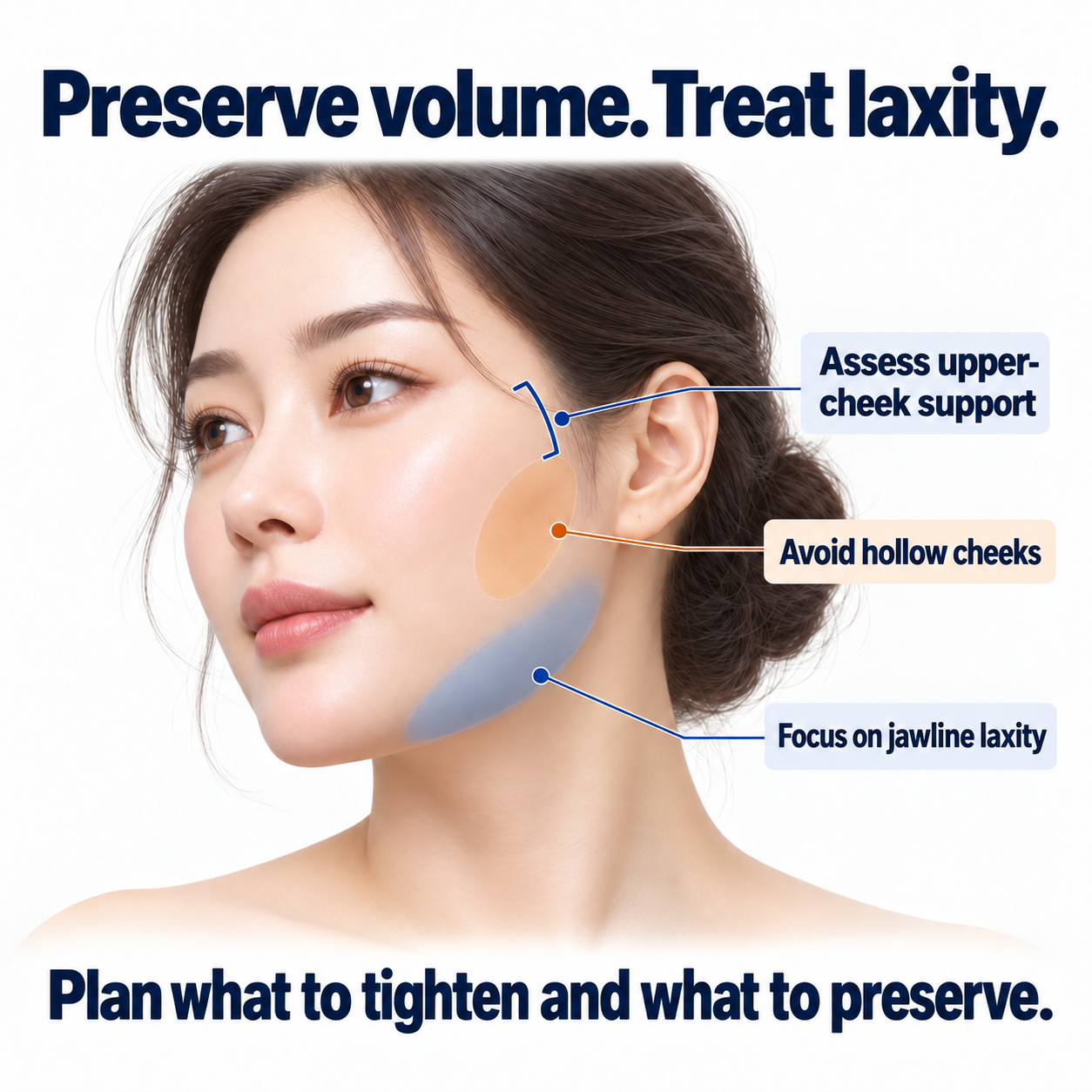
For a face with hollow lateral cheeks, I avoid treating that hollow area and focus on appropriate lower-face and jawline targets. I also assess the upper cheek separately for areas where support can be treated safely.
The aim is to improve laxity while preserving the volume the face needs. This is not blanket treatment across the cheekbone, and it does not eliminate the risk of unwanted fat loss. HIFU cannot refill an existing hollow. Sometimes the better decision is to reduce the treatment area or address volume loss first.
I check both the image and full tip contact
During Ultherapy, I use ultrasound imaging to check the treatment depth and coupling. I also confirm that the treatment surface is fully in contact with the skin. If an edge lifts or the contact is uneven, I reposition it before delivering energy.
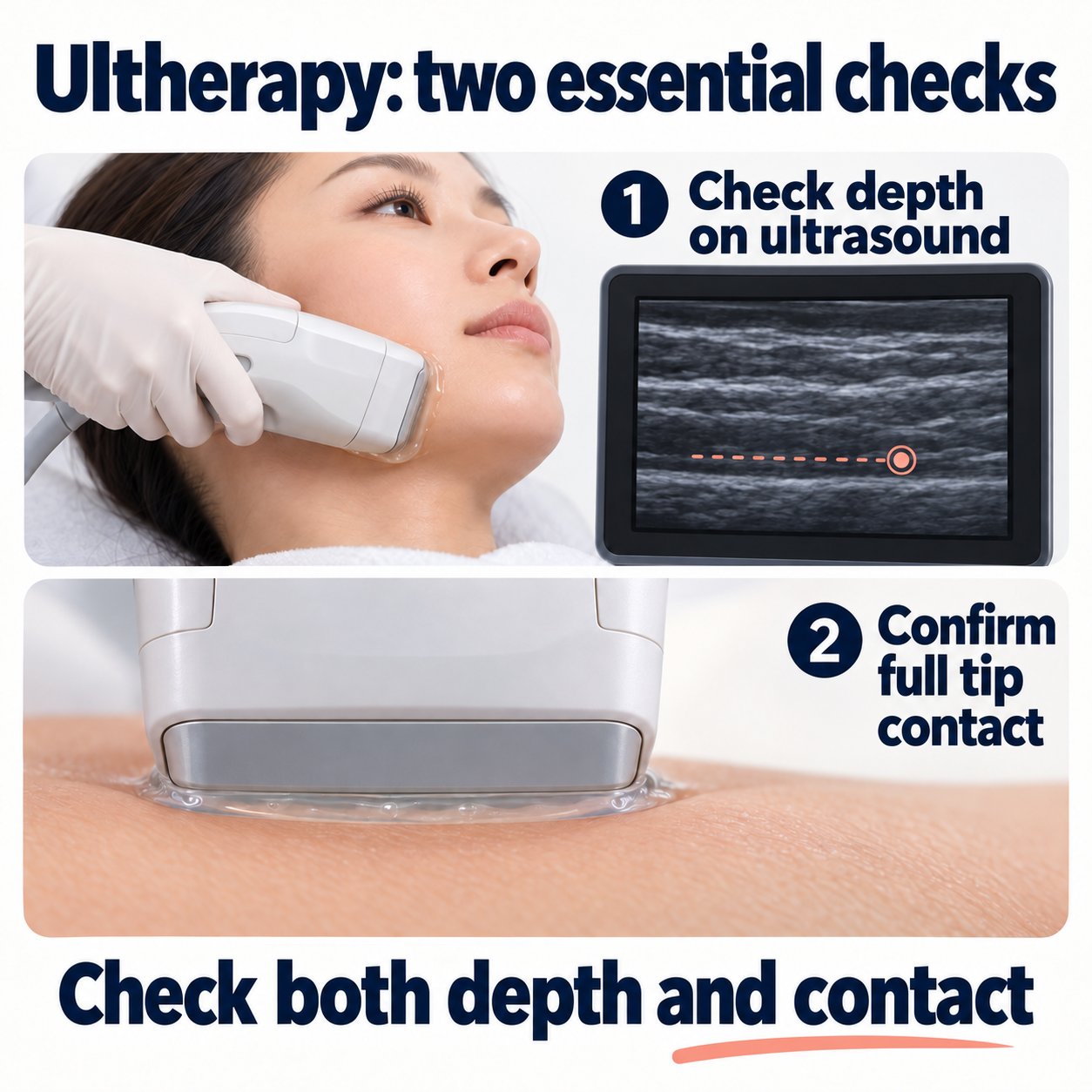
A 2022 safety consensus emphasizes anatomy, visualization, coupling and technique. It combined expert recommendations with device bench testing; it was not a randomized clinical trial proving one brand gives better results. Read the safety consensus.
5. When will I see results, and how long do they last?
Assess the main result at around three months. Early tightness or swelling does not show the full collagen-remodelling response.
Published microfocused ultrasound studies report improvements at six to twelve months in some groups. That is an observed follow-up range, not a guaranteed lifespan for every treatment or every Shurink model. Baseline laxity and the treatment plan matter. Systematic review of facial tightening.
A 2025 meta-analysis of 42 studies found improvements after MFU-V, but most studies were before-and-after studies rather than controlled comparisons. It supports a role for treatment; it does not settle “Ultherapy versus Shurink Universe” for an individual face. Read the meta-analysis.
Mild to moderate laxity is a more realistic target than a surgical facelift effect. A face with substantial excess skin needs a different discussion.
6. What is the downtime? What are wheals and welts?
There are no routine skin incisions, but redness, swelling, tenderness and bruising can occur. These are the typical courses listed in the Ulthera manufacturer’s face and neck instructions:
| Reaction | Typical course |
|---|---|
| Redness | Usually settles within a few hours |
| Mild swelling | Usually 3–72 hours |
| Linear swelling / welts | Usually resolves within one week |
| Tenderness | May last 2 days to 2 weeks |
| Bruising | May last 2 days to 2 weeks |
These are manufacturer-reported Ultherapy ranges, not a promise for every patient or a recovery timetable validated for every Shurink device. Instructions for use, adverse effects section.
A wheal is a raised patch of swelling. A linear welt is a raised line. The terms overlap, and appearance alone does not establish the cause. Persistent marks need assessment rather than being dismissed as “normal HIFU redness.”
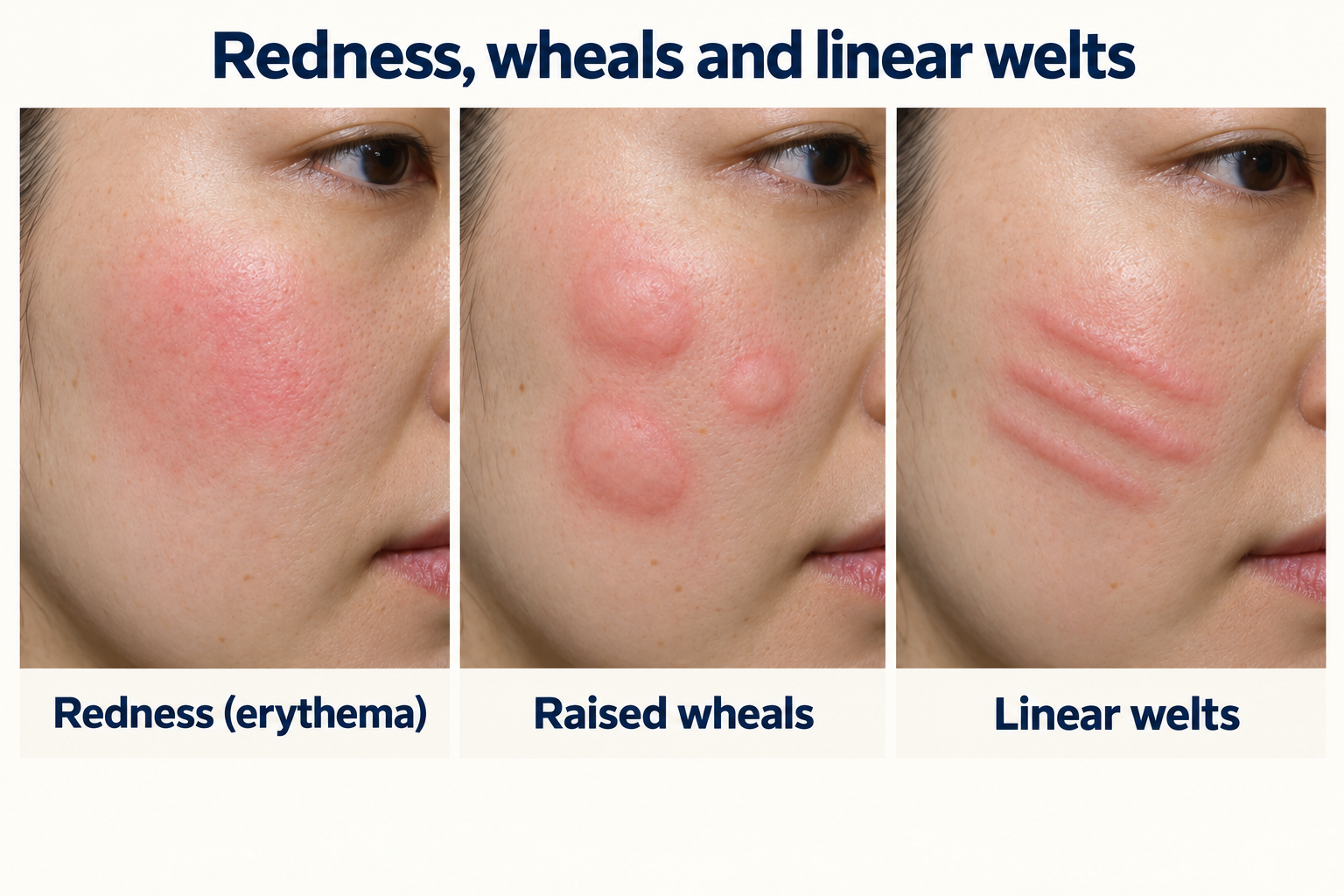
Illustrated skin reactions, not patient photographs.
For mild irritation, follow the clinic’s instructions for gentle cooling and skin care. Avoid rubbing or adding heat to an irritated area. Wheal-like reactions may need medical treatment after the cause is assessed.
Contact the treating clinic promptly for worsening pain, blisters, unusual skin colour, facial weakness or an asymmetric smile. Seek urgent care for any visual change. Do not wait for the timeline in a table when symptoms are concerning.
7. Planning Ultherapy or Shurink during a trip to Korea
Plan the treatment and the follow-up before booking it into a tight itinerary. The result will develop after a short holiday has ended.
- Confirm the exact machine: Ultherapy or Ultherapy PRIME; Ultraformer III or Ultraformer MPT.
- Ask who assesses and treats you: discuss cheek volume, skin laxity, pain control and previous fillers, threads or energy treatments.
- Get an itemized quote: treatment areas, planned shot distribution, anaesthesia and any taxes or additional charges.
- Arrange understandable consent and follow-up: know who to contact, how to send photographs and what to do after returning home.
Avoid relying on “zero downtime” for a wedding or important photos. Discuss your departure date and leave time for a review if needed; flight timing depends on the treatment and your recovery. See my Korea skin-treatment downtime guide.
8. Quick answers to common questions
Are 300 Ultherapy shots equivalent to 600 Shurink shots?
No fixed conversion exists. Energy delivery, treatment lines, modes, depths and coverage differ. Compare the proposed treatment plan, not the number alone.
Does a more painful treatment work better?
No. Pain is not a measure of lift. Tell the clinician about sharp or unexpectedly severe pain so contact, depth and settings can be reassessed.
Can HIFU cause cheek fat loss?
Yes, unwanted volume loss is a recognized risk. Existing hollow areas need to be identified before treatment. More full-face coverage is not automatically better. Safety review.
When should I repeat treatment?
Review the response at about three months before judging whether more treatment is needed. The next session should follow the degree of remaining laxity, previous treatment and tissue response, not an automatic monthly schedule.
My priorities are simple: treat the area that bothers you, choose the depth that fits your anatomy, preserve needed cheek volume, and check contact throughout treatment. Those decisions are central to how I plan both Ultherapy and Shurink.
Dr.Youro
Your own, Dr. Youro
References and product information
- Amiri M, et al. Microfocused Ultrasound With Visualization (MFU-V) Effectiveness and Safety: A Systematic Review and Meta-Analysis. Aesthetic Surgery Journal. 2025;45(3):NP86–NP94. doi:10.1093/asj/sjae228.
- Pavicic T, et al. Microfocused ultrasound with visualization: Consensus on safety and review of energy-based devices. Journal of Cosmetic Dermatology. 2022;21(2):636–647. doi:10.1111/jocd.14666.
- Contini M, et al. A Systematic Review of the Efficacy of Microfocused Ultrasound for Facial Skin Tightening. International Journal of Environmental Research and Public Health. 2023;20(2):1522. doi:10.3390/ijerph20021522.
Product information: Ulthera System US Instructions for Use, Rev. J (2021); Classys Ultraformer MPT; Classys Korean and international product names.
Adapted for international readers from my original Korean article on Naver.


Leave a Reply