
A DOCTOR’S GUIDE TO SKIN TREATMENTS IN KOREA
Hello, I’m Dr. Youro, a physician in Korea.
“Is Titanium lifting a tightening treatment or a pigment laser? Can I have it during a short trip to Korea?”
Titanium lifting uses three laser wavelengths to heat tissue and improve skin quality and mild laxity. It is often offered with minimal downtime, but “Titanium toning” is not the same treatment as Q-switched or pico laser toning for pigmentation.
Routine activities are generally possible the same day. For an important event, consider about one week of buffer, or about two weeks for a first treatment. These are planning margins, not a proven peak-result date or a guarantee of recovery.
In this guide: What it is / How it works / Toning / Results / Downtime / Planning your visit
1. What is Titanium lifting in Korea?
In Korean clinics, “Titanium lifting” usually refers to a facial treatment protocol using Alma’s Soprano Titanium platform. It delivers 755 nm, 810 nm and 1064 nm light together through a cooled handpiece. Alma also uses the name TitaniumLift for its facial protocol. The platform is widely known for laser hair removal, so the device name alone does not tell you which treatment you are booking. Alma’s protocol description.
Confirm the exact model, facial treatment area and intended goal. “Titanium lifting,” “Titanium toning” and a routine Soprano hair-removal appointment should not be treated as interchangeable bookings.
2. How does it tighten skin?
When laser light is absorbed by tissue, it becomes heat. Repeated pulses build up thermal exposure, while contact cooling helps protect the epidermis, the outer skin layer. The intended longer-term response is remodeling of collagen and other supporting structures in the dermis.
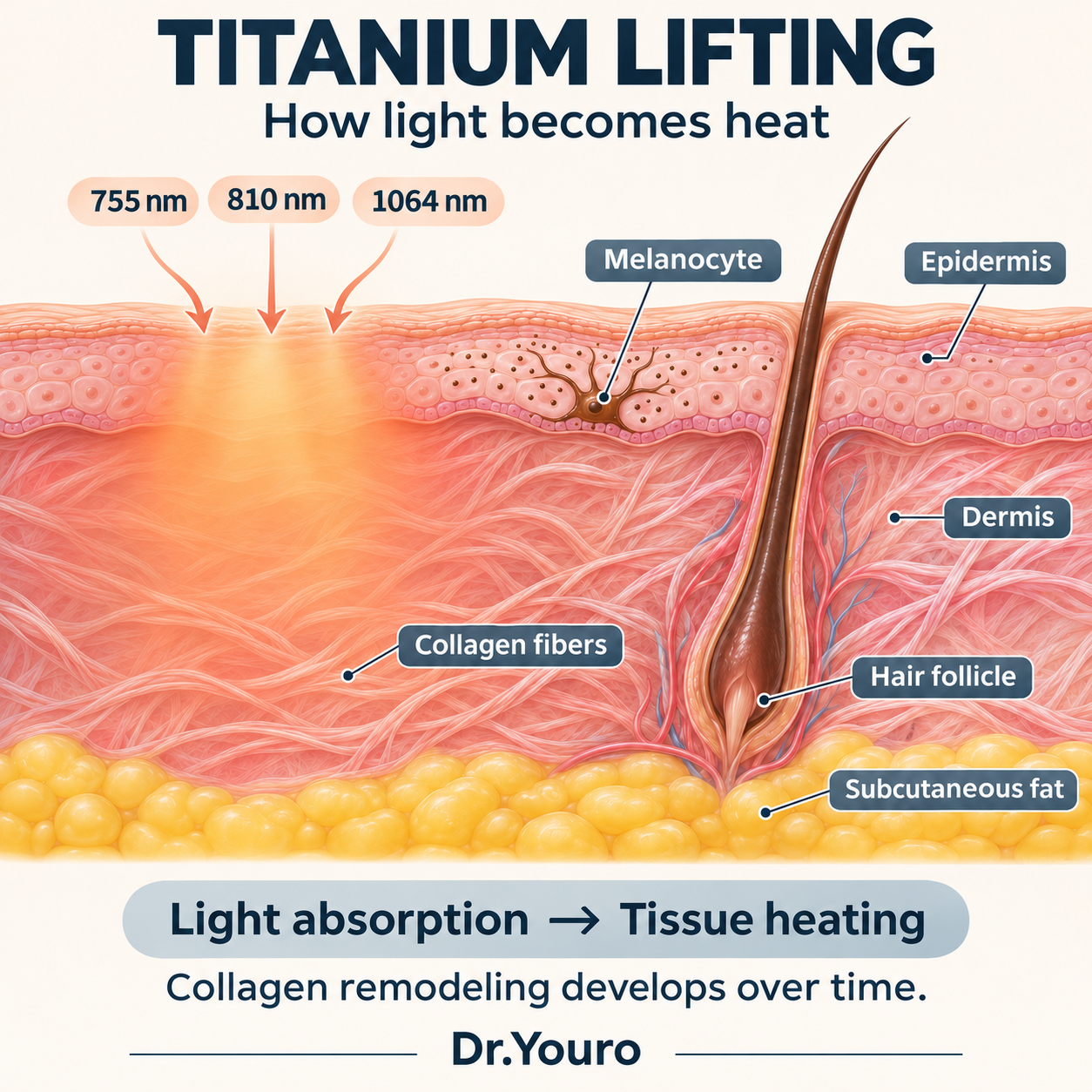
RF devices such as Thermage create heat through electrical energy. HIFU devices such as Ultherapy concentrate ultrasound at small focal treatment points. Titanium uses absorbed laser light, with a different heating pattern. A shared use of heat does not make their tissue effects or results equivalent.
STACK versus SHR: what changes?
| Mode | How energy is delivered |
|---|---|
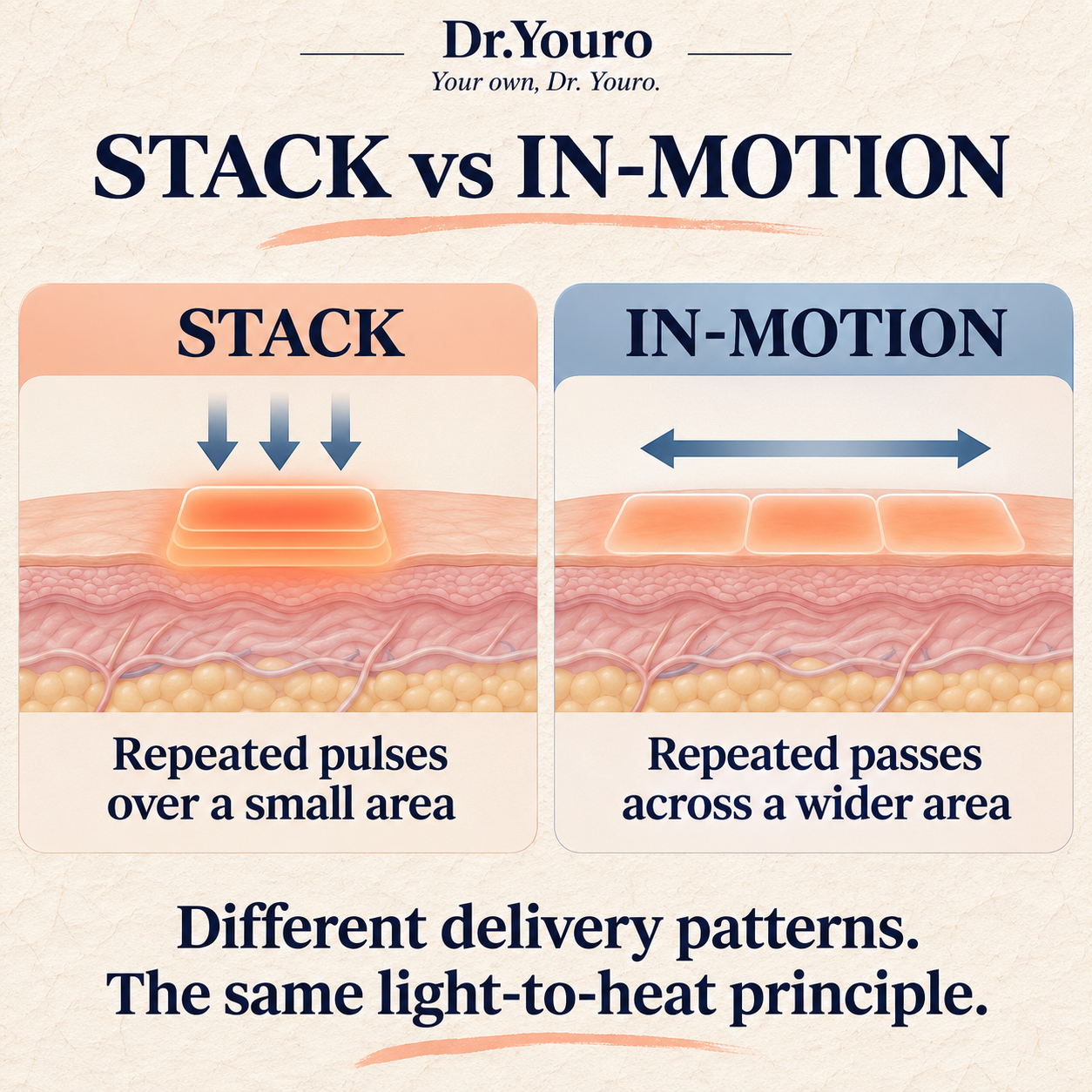
| SHR STACK | Repeated pulses over a small area before repositioning. |
| SHR motion | Repeated passes while the handpiece moves across a broader area. |
Both use heat accumulation. They are delivery methods, rather than separate “lifting-only” and “toning-only” mechanisms. The platform also has an HR classic mode; the two modes above are the focus of this facial discussion. Fixed claims such as “STACK always treats exactly 8 mm” oversimplify how light travels through different faces. Manufacturer’s mode descriptions.
Why might skin look tighter immediately?
New collagen cannot explain a change seen immediately after treatment. Thermal contraction of existing collagen is a proposed explanation for early tightening, but the Titanium studies discussed below do not directly establish how much immediate contraction occurs. An early change and a later remodeling response are different observations.
For focused ultrasound, see my Ultherapy versus Shurink guide.
3. Is Titanium toning a treatment for melasma?
Do not assume “toning” means pigment removal. Melanin is made by melanocytes near the base of the epidermis and packaged into melanosomes. These pigment-containing structures are transferred to surrounding skin cells.
Titanium’s wavelengths can be absorbed by melanin. Absorption creates heat; whether pigment structures are damaged depends on the pulse duration and energy. In hair removal, melanin in the hair absorbs light and the resulting heat damages the follicle. That is a demonstrated action of this platform. Triple-wavelength hair-removal study.
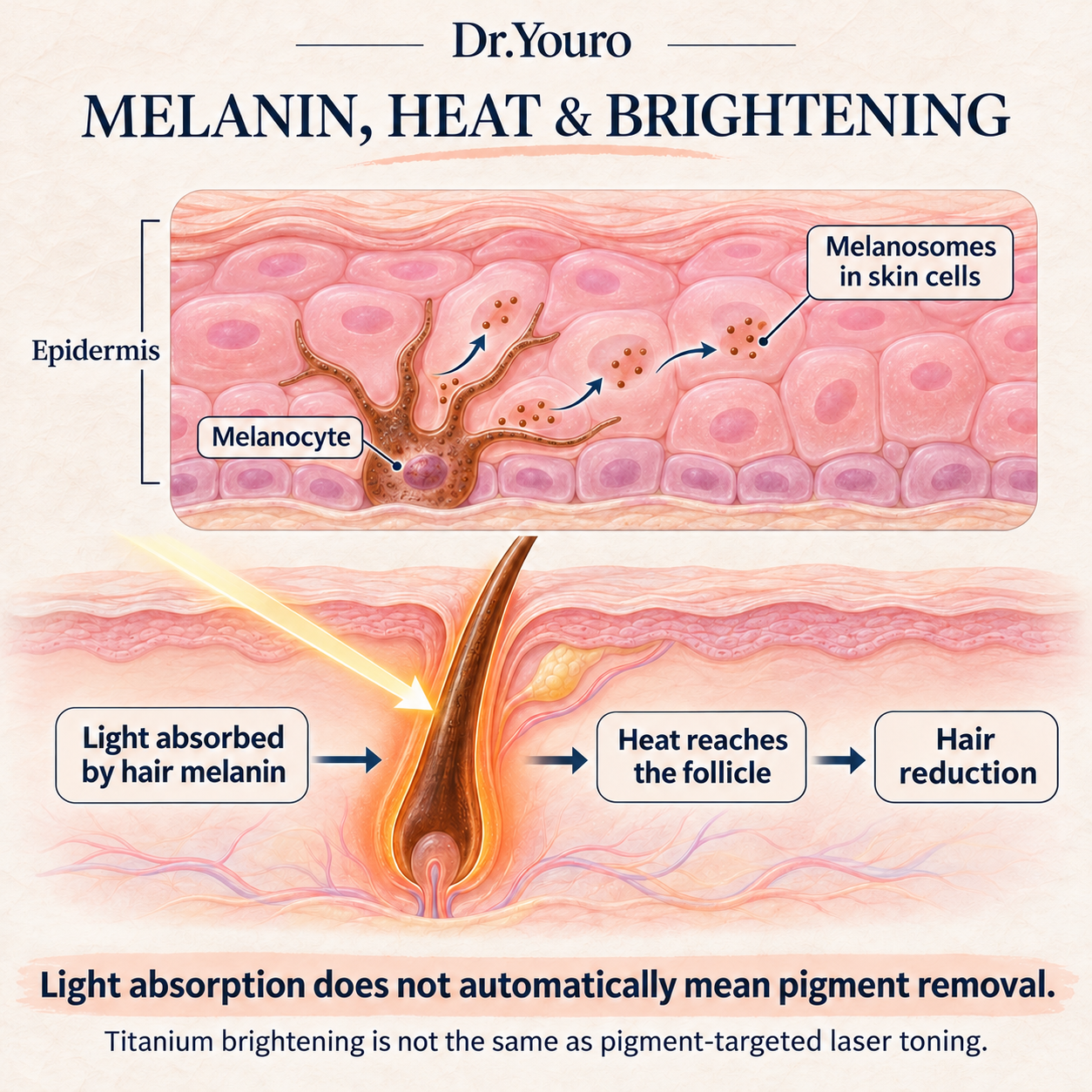
Less visible hair and changes in skin texture may contribute to a clearer appearance, but this is an interpretation, not direct proof of facial pigment clearance. In particular, body hair-removal research does not establish that a facial lifting protocol reliably removes fine facial hair or treats melasma.
Q-switched toning uses much shorter, nanosecond pulses; pico lasers use picosecond pulses. Sharing a wavelength does not make these treatments equivalent. If brown patches or melasma are your main concern, ask for a pigment diagnosis and a targeted plan. Read my pico versus laser toning guide.
4. What results are realistic, and how long do they last?
The realistic discussion is about mild laxity, skin texture and subtle contour improvement. Significant excess skin, deep folds and volume loss need their own assessment.
A preliminary study of 28 women used five treatments at two-week intervals. The abstract reports clinical improvement and increased collagen and elastic bundles in biopsies taken two weeks after the final session. It supports a remodeling response, but does not establish a result from one holiday appointment. Read the study abstract.
A separate uncontrolled case series of 10 women reported contour improvement after up to three treatments. It included six-month assessment, but its abstract and methods describe the follow-up starting point differently. It therefore should not be turned into a precise “six months after your last treatment” promise. It also did not directly measure immediate collagen contraction. Read the full case series.
In my clinical experience, the noticeable benefit patients described often lasted around one to three months. That is a practice observation, not a measured average from a controlled trial. Re-treatment should follow your response and goals rather than a guaranteed expiry date.
5. Why does the treatment plan matter?
When someone says a previous session did little, I first look at where and how treatment was delivered. My priorities are the area that bothers the patient, skin thickness, facial volume and the cause of the apparent sagging.
I monitor skin response and discomfort while adjusting movement, repetition and cooling. More heat or more pain is not automatically more effective. A useful consultation explains which areas will be treated, which will be preserved and why.
Dark moles, tattoos and permanent makeup need particular attention because they can absorb energy. Eyebrows, hairlines, sideburns and a beard you want to keep should be identified before treatment. Protection must be selected by the clinician; simply covering a tattoo does not make direct laser exposure safe.
6. How much downtime should you allow?
Alma’s Korean information says washing, makeup and normal activities are possible immediately after treatment. That describes routine recovery, not a guarantee that every face will look unchanged. Redness, warmth, swelling and tenderness can occur. Official recovery information.
Allow about one week, or about two weeks for your first treatment. This is my practical scheduling advice to leave room for skin reactions, not an evidence-based peak-effect window. If you previously needed longer to settle, allow longer again.

Keep skin care gentle and use sun protection. Avoid extra heat and friction while the skin is irritated, and follow the clinic’s aftercare instructions. Worsening pain, blisters or a marked color change deserve prompt contact with the treating clinic rather than waiting for a planned recovery date.
7. Planning Titanium lifting during a trip to Korea
Same-day routine activity does not mean the best appointment is immediately before your flight, wedding or photoshoot. Leave enough time for an assessment if a reaction occurs.
- Confirm the device and protocol. Ask whether the booking is facial tightening, hair removal or a combination, and which areas are included.
- Discuss your skin and treatment history. Mention melasma, tanning, tattoos, permanent makeup, previous energy treatments, injectables and any areas of unwanted hollowing.
- Request an itemized quote. Compare treatment area, planned sessions, clinician involvement, add-ons and taxes. A device name or total energy figure alone does not describe the service.
- Arrange clear communication. Confirm the consultation and consent language, who performs the treatment, and how follow-up works after you leave Korea.
- Share your itinerary. Discuss the event date and departure date with the treating clinician. A routine downtime estimate is not individualized clearance to fly.
8. Quick answers
Can one session replace Ultherapy or Thermage?
No fixed equivalence exists. These devices deliver different forms and distributions of energy. Choose according to the tissue problem and treatment plan, not a claim that one session replaces another brand.
Is it painless and risk-free?
No. Cooling improves comfort, but pain, burns and pigment changes remain possible. Strong or unexpected pain should be reported during the procedure.
Should I book several sessions during a short stay?
Do not compress a course simply to fit your holiday. Published protocols spaced sessions weeks apart. Discuss whether one treatment is worthwhile and whether follow-up is realistic.
Is the facial lifting use approved where I live?
Device availability, model names and approved indications can differ between Korea, the UK and the US. Ask the clinic about the exact device and indication; approval for hair removal does not automatically establish approval for facial lifting.
My priority is a clear plan: what we are treating, how we will deliver energy, and what you can realistically expect. Understanding the treatment comes before choosing it.
Dr.Youro
Your own, Dr. Youro
References and product information
- Jo JY, Suh DH, Park H, Lee SJ, Ryu HJ. Skin rejuvenating effect of a combined triple-wavelength (755 nm, 810 nm, and 1064 nm) laser: a preliminary study. Lasers in Medical Science. 2023;38:272. doi:10.1007/s10103-023-03936-6. Abstract reviewed.
- Choi J, Yi KH. Using multiple wavelengths in order to improve the facial contouring procedure by the lipolysis and sculpting. Journal of Cosmetic Dermatology. 2024;23:464–469. doi:10.1111/jocd.16021.
- Gold MH, Weiss E, Biron J. Novel laser hair removal in all skin types. Journal of Cosmetic Dermatology. 2023;22:1261–1265. doi:10.1111/jocd.15674. Hair-removal research, not a facial brightening trial.
- Mun JY, et al. A low fluence Q-switched Nd:YAG laser modifies the 3D structure of melanocyte and ultrastructure of melanosome by subcellular-selective photothermolysis. Journal of Electron Microscopy. 2011;60:11–18. doi:10.1093/jmicro/dfq068. Mechanism comparison, abstract reviewed.
Cover product photograph: Alma Soprano Titanium brochure.
Product information: Alma TitaniumLift and Soprano Titanium, Alma Korea.
Adapted for international readers from my original Korean article on Naver.


Leave a Reply