A GUIDE TO SKIN TREATMENTS IN KOREA
Hello, I’m Dr. Youro, a physician in Korea. If you are considering Rejuran during a visit to Korea, you may have heard two things: it can improve skin quality, and the injections can hurt.
But does more pain mean a better result? Is Rejuran HB less effective because it contains an anesthetic? And how long will those little bumps be visible?
What is Rejuran?
Benefits and how it may work
What the research photos show
Pain and Rejuran HB
Injection bumps
Downtime and safety
Treatment intervals and duration
Planning treatment in Korea
Common questions
1. What is Rejuran made of?
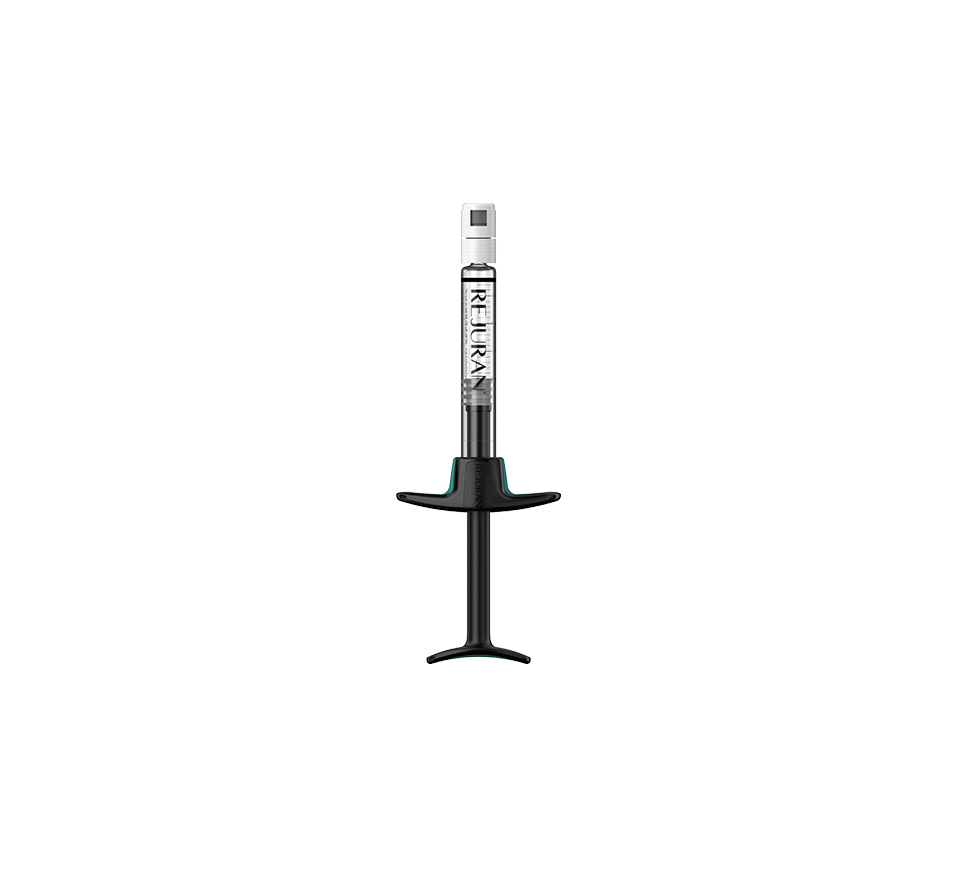
Rejuran is an injectable product based on polynucleotides, or PN, purified from salmon-derived DNA. These are chains of the small building blocks that make up DNA. The treatment does not inject living cells or ready-made collagen.
It is generally discussed as a treatment for skin quality, particularly fine lines, roughness and hydration. Those goals are different from replacing substantial lost facial volume or lifting a sagging jawline.
2. What benefits can you expect, and why?
Hydration: helping the treated tissue retain water
PN is a water-loving polymer that can form a viscous gel. Its ability to associate with water may contribute to hydration around the treated area. Think of adding a material that can hold water, rather than simply adding a splash of water. This does not create a permanent reservoir in your skin.
A randomized split-face study enrolled 27 people. Each received PN around one eye and non-crosslinked hyaluronic acid around the other, for three sessions two weeks apart. Hydration and elasticity improvement rates favored PN, although improvements declined over time in both groups. Roughness and pore-volume measures also favored PN. Overall aesthetic ratings and dermal-density improvement did not differ significantly. Read the trial abstract.
Texture and fine lines: hydration plus possible tissue responses
The dermis, beneath the epidermis, contains collagen and other material that supports the skin. Its fibroblasts make collagen, but they also respond to signals from nearby cells.
In a 2025 laboratory and animal study, PN altered signaling in aged immune cells called macrophages. Signals from these cells were associated with increased collagen production by fibroblasts. In plain language, researchers studied whether PN changes how the skin’s collagen-making cells and their neighbors work together. This is a proposed biological explanation, not proof that the same pathway produces a predictable result in every person. Read the experimental study abstract.
In a separate human study, 28 of 30 participants completed follow-up, with improvements in crow’s-feet scores at 18 weeks after the first injection. Without a control group, that study cannot establish how much of the change was caused by PN alone. Read the crow’s-feet study abstract.
The skin barrier: a separate question
Holding water and preventing water from escaping are related, but different functions. The skin barrier is mainly associated with the outermost epidermal layer, the stratum corneum. Injecting a water-binding material deeper into the skin does not by itself prove that this outer barrier becomes stronger.
A 2024 study found improved barrier-related measures after a PN and hyaluronic acid hydrogel was applied to mechanically damaged mouse skin. This was a topical combination treatment in animals, not ordinary Rejuran injections in people. It supports further research, not a promise of barrier repair. Read the barrier study.
3. What do clinical photographs actually show?
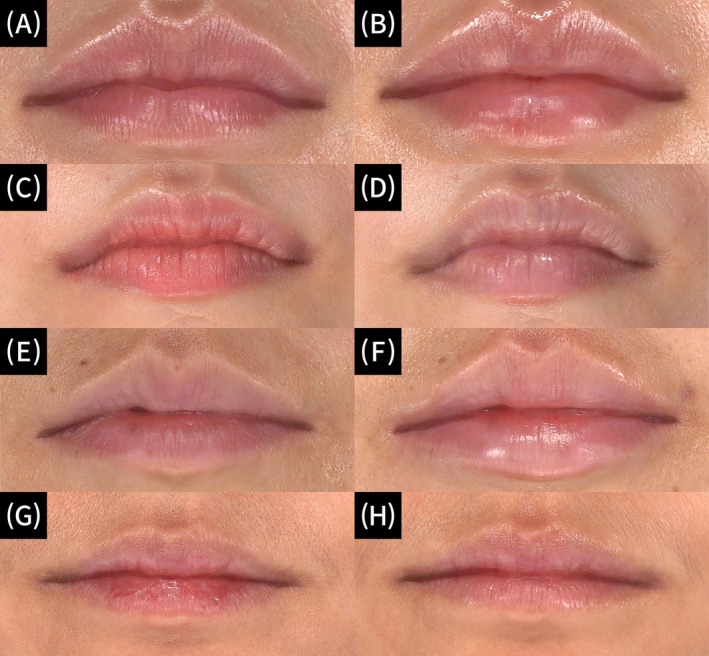
Dry, chapped lips
In a prospective study, 27 of 30 participants completed three Rejuran treatments, three weeks apart. Lip wrinkle and roughness scores improved. The photographs compare baseline with week nine, three weeks after the final treatment. There was no control group, and lip findings cannot simply be applied to the whole face.
Facial redness
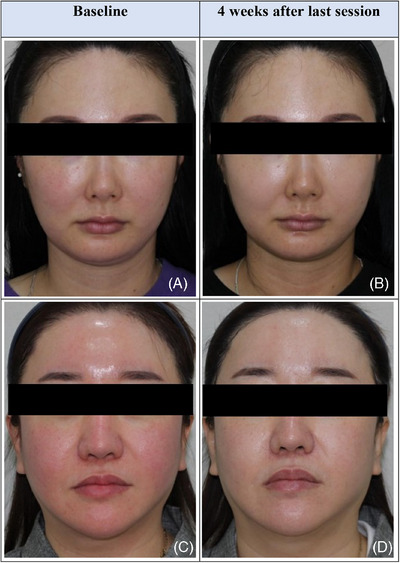
A report of two women described reduced facial redness after three sessions two weeks apart. However, the injected mixture contained Rejuran, non-crosslinked hyaluronic acid and lidocaine. It was neither Rejuran alone nor a trial of the packaged HB product. Two uncontrolled cases cannot establish effectiveness for redness generally.
A systematic review covering nine studies and 219 participants rated the included evidence as low or moderate quality. Products, treatment areas and methods varied. My interpretation is that PN is a reasonable topic to discuss for skin quality, while claims that it repairs every skin problem go beyond the evidence. Read the systematic review.
4. Why does Rejuran hurt, and how is HB different?
Discomfort comes from both the needle punctures and the pressure of material entering the tissue. Treatment area, injection technique, anesthetic plan and individual sensitivity all matter. More pain does not establish that the treatment was more effective.
Rejuran HB formulations combine PN with hyaluronic acid and lidocaine. Hyaluronic acid binds water. Lidocaine is a local anesthetic that reduces nerve-signal transmission by blocking sodium channels. That is why an anesthetic-containing formulation may feel less painful. It does not make the procedure pain-free, and lower pain is not evidence of a weaker result.
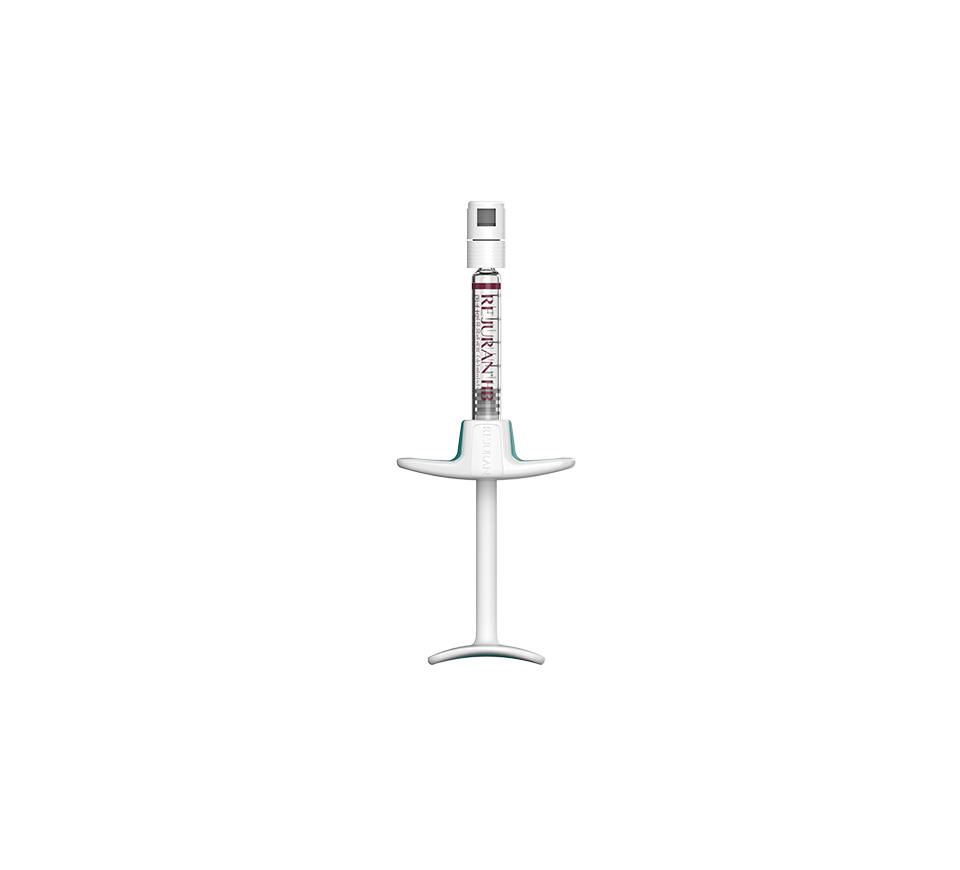
| Question | Rejuran | HB formulations |
|---|---|---|
| Main distinction | PN-based formulation | PN, HA and lidocaine |
| Pain control | Discuss a separate anesthetic plan | Includes a local anesthetic, still may hurt |
| What to check | Exact product, volume and treatment area | Exact HB version and anesthetic allergy history |
The Korean HB plus instructions specify temporary improvement of adult crow’s feet. That is narrower than every skin-quality claim you may encounter online. Product labels, treatment sites and approvals also differ between countries. Official HB plus instructions, HB instructions, lidocaine prescribing information.
5. What are the small bumps after Rejuran?
In Korean clinics, you may hear these called embossing. In English, they are usually described as injection bumps, papules or wheals: small raised areas appearing immediately where material was injected.
With small intradermal injections, the added fluid temporarily stretches the dermis. This layer is a dense network of tissue, not an empty space. Fluid spreads through it, but the injected volume cannot disperse completely at once. The overlying skin therefore rises into a little bump. Viscosity, volume per point, depth and skin thickness influence how visible it is.
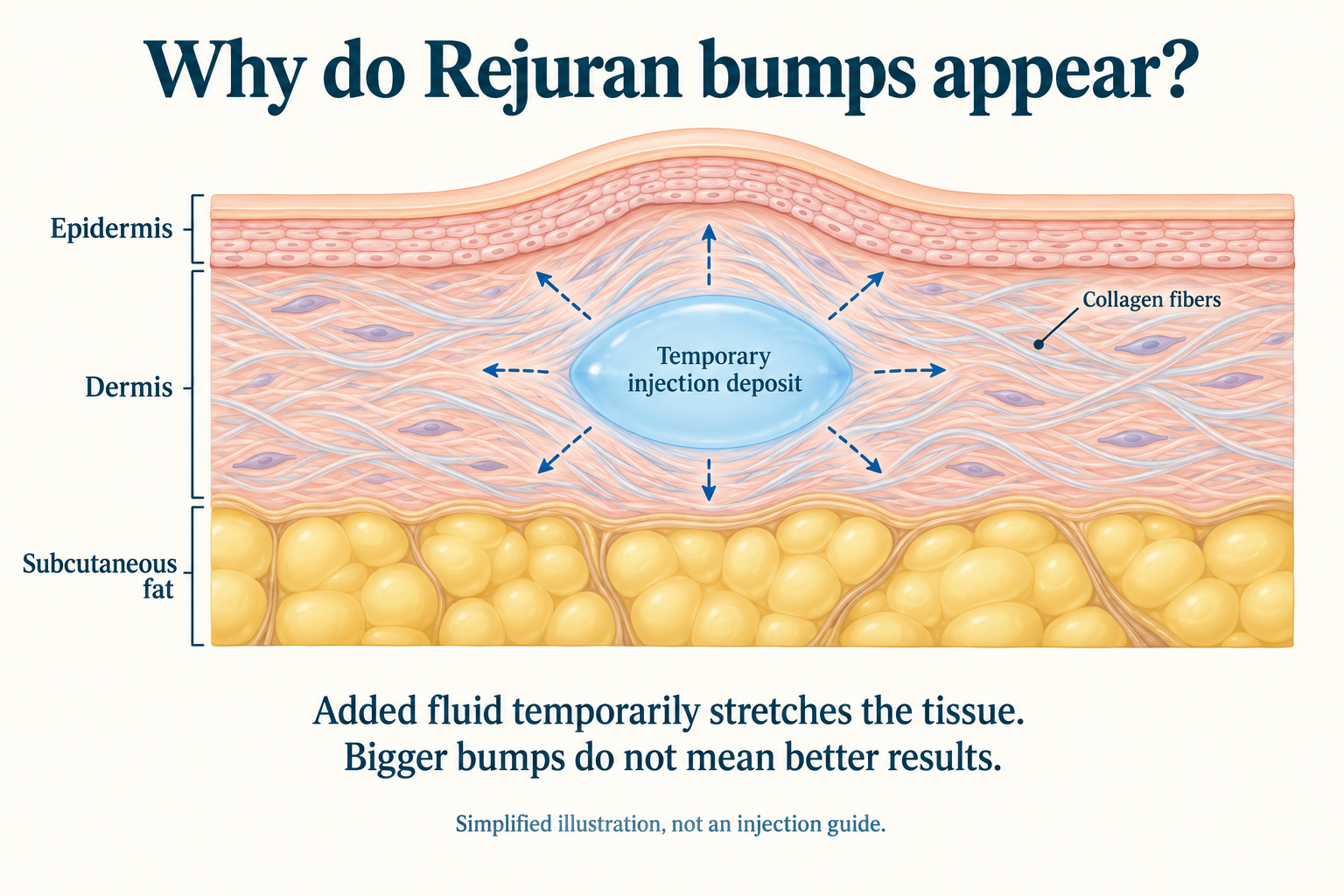
A small bump can be a useful procedural sign of intradermal placement. It is not a score for the final result. A bump alone cannot confirm that every injection had the ideal depth or dose. Larger or longer-lasting bumps are not necessarily better, and their absence does not automatically mean failure. Different injection methods produce different appearances.
Bumps often settle within roughly one to three days, although some last longer. That estimate describes short-term recovery, not how long the benefit lasts. Patient consent and recovery guidance. The underlying mechanics of intradermal fluid delivery are also described in intradermal injection research, which is not a Rejuran efficacy trial.
6. How much downtime should you plan for?
Returning to ordinary activities and looking completely free of treatment marks are different milestones.
- Bumps and redness: often improve within one to three days.
- Needle marks and tenderness: may remain noticeable for several days.
- Bruising: can remain visible for one to two weeks, particularly in bruise-prone areas.
These are approximate planning ranges, not guaranteed deadlines. Injection technique, location, product and your tendency to bruise matter. The HB plus label notes that local inflammatory reactions may last around a week. Manufacturer safety information. Bruising and redness timelines are also described in clinic patient information, rather than a controlled recovery study.
For an important photo shoot or event, I would leave at least a week, and closer to two weeks if visible bruising would be a problem. This is a scheduling buffer, not a promise that everyone will be clear by then.
Tell the clinic about lidocaine reactions
If you have a diagnosed lidocaine allergy, or have reacted after dental or other local anesthesia, tell your doctor before considering HB. Describe what happened even if you do not know whether it was an allergy. Reactions to anesthesia are not all allergic, but the history still needs assessment.
Difficulty breathing, throat swelling or rapidly developing widespread hives need immediate medical attention. Notify the treating team immediately. If you are outside the clinic in Korea, call 119. Seek urgent assessment for severe or worsening pain, unusual pale or dusky skin, or vision changes. These should not be dismissed as ordinary injection bumps.
Persistent hard lumps, increasing redness, warmth or pain also need review. Discuss medications, pregnancy or breastfeeding, immune conditions, prior injectable treatments and ingredient allergies before treatment. Do not stop prescribed medicines on your own. Follow the aftercare instructions for the exact product used.
7. How often is Rejuran repeated, and how long does it last?
Separate the initial course from maintenance. An international distributor brochure suggests three to four treatments, three to four weeks apart, with maintenance around every six months. This is a product-guide schedule, not a universally proven best interval. The 27-person eye-area trial used three treatments two weeks apart. Distributor schedule, clinical trial.
There is no good basis for saying everyone must repeat it every three months. Your clinician should consider your response, remaining benefit, skin condition and treatment burden.
A maintenance interval is not an expiry date. Results do not suddenly drop to zero on the day three or six months have passed. Some change may remain, while hydration, texture and fine-line measures can fade at different rates.
Equally, “it stimulated fibroblasts” does not prove that an improved skin environment will persist indefinitely. Existing studies do not establish a single reliable duration for every patient or every formulation. Judge the response after early swelling settles, using comparable photographs and the concern you actually wanted to improve.
8. Planning Rejuran during a trip to Korea
A short visit may allow one treatment, but not the repeated course used in many studies. Do not compress a multiweek schedule into a few days just to fit a trip.
- Ask for the exact product name, total volume and treatment area. A price “per syringe” is difficult to compare without these details.
- Confirm who performs the injections and whether consultation, anesthesia, tax and follow-up are included.
- Arrange consultation and written aftercare in a language you understand.
- Leave time for review before departure where possible. Ask how to contact the clinic and obtain records after returning home.
- Plan important photographs around the possibility of bruising. Being able to sightsee is different from being ready for a close-up photograph.
There is no single travel or flight-clearance rule that fits every treatment plan. Discuss your departure date, any combined procedures and your individual recovery with the treating clinician.
9. Common questions
Is Rejuran the same as a PDRN injection?
No. Both belong to the broader family of DNA-derived materials, but they are not interchangeable products. PN generally describes longer chains used in viscous formulations, while PDRN generally refers to shorter DNA fragments. Terminology is not perfectly uniform across publications, so the actual product and formulation matter more than the abbreviation alone. A PDRN wound-healing study does not automatically prove the same outcome for a Rejuran cosmetic injection. PN and PDRN review.
Does it work better on damaged or burned skin?
Reports of PN treatment for scars, including burn-related scars, are not direct comparisons between healthy and burned skin. They cannot establish that damaged skin benefits more, or that both groups benefit equally. A healed burn scar and an acute burn wound are also different problems. In particular, the HB plus label says not to use it on inflamed or infected damaged skin. Scar-treatment report, HB plus label.
Will it erase pores or fill deep acne scars?
No. Improved pore measurements or texture are not the same as permanently removing pores or correcting substantial scar depressions. A tethered scar may need release with subcision. Other scars may require resurfacing, focal chemical treatment, punch techniques or selected volume correction.
Collagen-stimulating products, including PDLLA formulations, may have a role in selected depressions. That does not make Juvelook Volume the right choice for every acne scar. Product formulation, depth and complication risk matter. If deep scars are the main concern, start with scar assessment rather than assuming repeated Rejuran is the answer. American Academy of Dermatology scar-treatment guide.
You do not need to decide before you understand the treatment. I will keep explaining the mechanisms, practical differences and limitations of aesthetic procedures here.
Your own, Dr. Youro
Related reading
- Skin Botox in Korea: pores, fine lines and what to expect
- Skin treatment downtime in Korea: plan your trip
- Read the original Korean article on Naver
References
- Lee YJ, et al. Comparison of the effects of polynucleotide and hyaluronic acid fillers on periocular rejuvenation: a randomized, double-blind, split-face trial. J Dermatolog Treat. 2022;33(1):254–260. DOI. Abstract reviewed.
- Kim JH, et al. Effects of Polynucleotide Dermal Filler in the Correction of Crow’s Feet Using an Antera Three-Dimensional Camera. Aesthetic Plast Surg. 2022;46:1902–1909. DOI. Abstract reviewed.
- Lampridou S, et al. The Effectiveness of Polynucleotides in Esthetic Medicine: A Systematic Review. J Cosmet Dermatol. 2025;24:e16721. DOI.
- Byun KA, et al. Polynucleotides Enhance Collagen Synthesis via Modulating Phosphoenolpyruvate Carboxykinase 1 in Senescent Macrophages: Experimental Evidence. Int J Mol Sci. 2025;26:8720. DOI. Abstract reviewed, laboratory and animal evidence.
- Rho NK, Park HJ, Kim HS. Clinical Efficacy and Safety of a Highly Purified Polynucleotide for Dry and Chapped Lips: A Prospective, Multicenter Study. J Cosmet Dermatol. 2025;24:e70224. DOI.
- Lee DK, et al. Clinical effects of polynucleotide with hyaluronic acid intradermal injections on facial erythema: Effective redness treatment using polynucleotides. Skin Res Technol. 2024;30:e70034. DOI.
- Ha YJ, et al. The Effect of Polynucleotide-Hyaluronic Acid Hydrogel in the Recovery After Mechanical Skin Barrier Disruption. Skin Res Technol. 2024;30:e70068. DOI.
- Kim ST. Comparison of Polynucleotide and Polydeoxyribonucleotide in Dermatology: Molecular Mechanisms and Clinical Perspectives. Pharmaceutics. 2025;17:1024. DOI.
- PharmaResearch. Official Korean instructions for Rejuran, Rejuran HB and Rejuran HB plus. Product guides and recovery resources are linked beside the relevant discussion above.
Updated October 7, 2026. Educational information to support a consultation, not an individualized treatment plan.


Leave a Reply