By Youro Kang, MD, a licensed physician in South Korea. Updated October 6, 2026.
Masseter Botox can slim a jaw made wider by enlarged chewing muscles. Possible side effects include chewing weakness, an uneven smile, a bulge when clenching, and sunken-looking cheeks. These changes have different causes, so they should not all be treated with extra Botox.
Hi, I’m Dr. Youro. If you are considering jaw Botox during a trip to Korea, the useful question is: how can we reduce the muscle while preserving comfortable chewing, your smile, and the facial volume you want to keep?
Compare side effects / Recovery / Grinding vs slimming / Planning treatment in Korea / FAQ
What is masseter Botox, and is it the same as jaw Botox?
The masseter is a chewing muscle at the side of your jaw. Botulinum toxin reduces its contraction; over time, the muscle can become smaller. This can soften lower-face width when enlarged muscle contributes to it. It does not reshape the jawbone.
In Korea, “square-jaw Botox” usually refers to this treatment. “Jaw Botox” is less precise, so confirm which muscles are included. Botox is also a brand name: a clinic using the word casually may be offering a different botulinum toxin product.
A 187-person randomized trial found reduced lower-face volume and masseter prominence at 90 days. That supports muscle-based contouring, but does not make every broad jaw a suitable candidate.
Which masseter Botox side effect am I noticing?
| Change | Possible explanation | Next step |
|---|---|---|
| Uneven or restricted smile | Nearby expression muscle affected | Contact the treating clinician |
| Bulge when clenching | Uneven muscle weakening | Examine movement, sometimes with ultrasound |
| Sunken-looking cheeks | Changed muscle volume and facial proportions | Reassess before more slimming treatment |
| Tired chewing | Reduced chewing-muscle force | Report troublesome or persistent weakness |
This is a guide to patterns, not a diagnosis. A lump that is painful, enlarging, or present at rest should not automatically be labelled a Botox-related muscle bulge.
Why does my smile look uneven after masseter Botox?
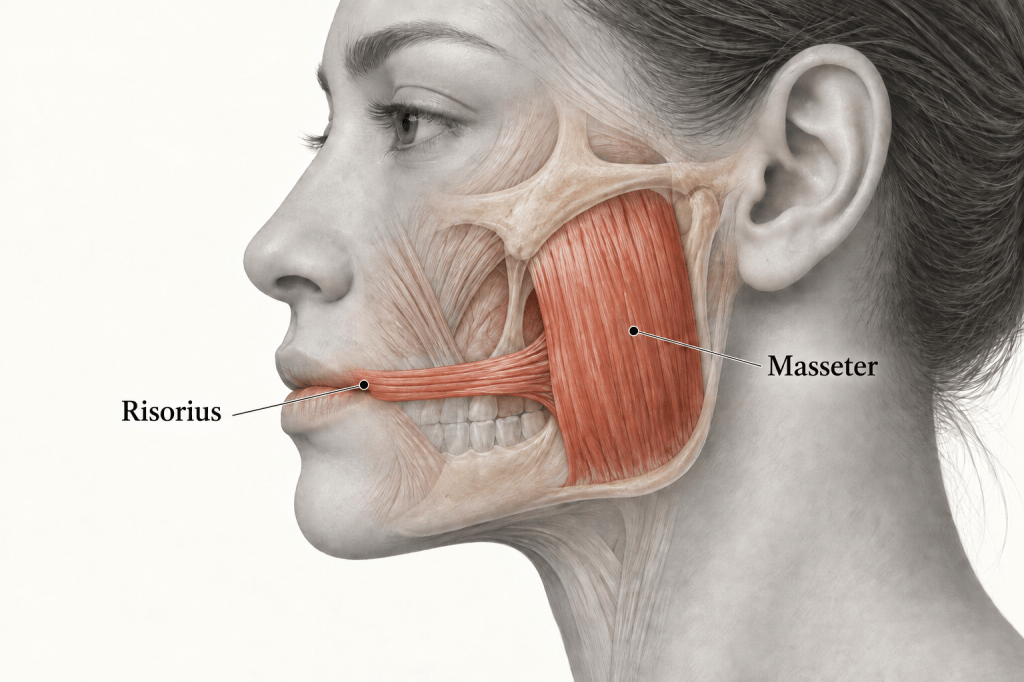
One possible reason is an effect on the risorius, a nearby muscle that helps draw the corner of the mouth sideways. Its relationship to the masseter varies between people. An anatomical study of 48 hemifaces helps explain why treatment near the masseter’s front border can affect expression. It does not prove that one injection technique eliminates the risk.
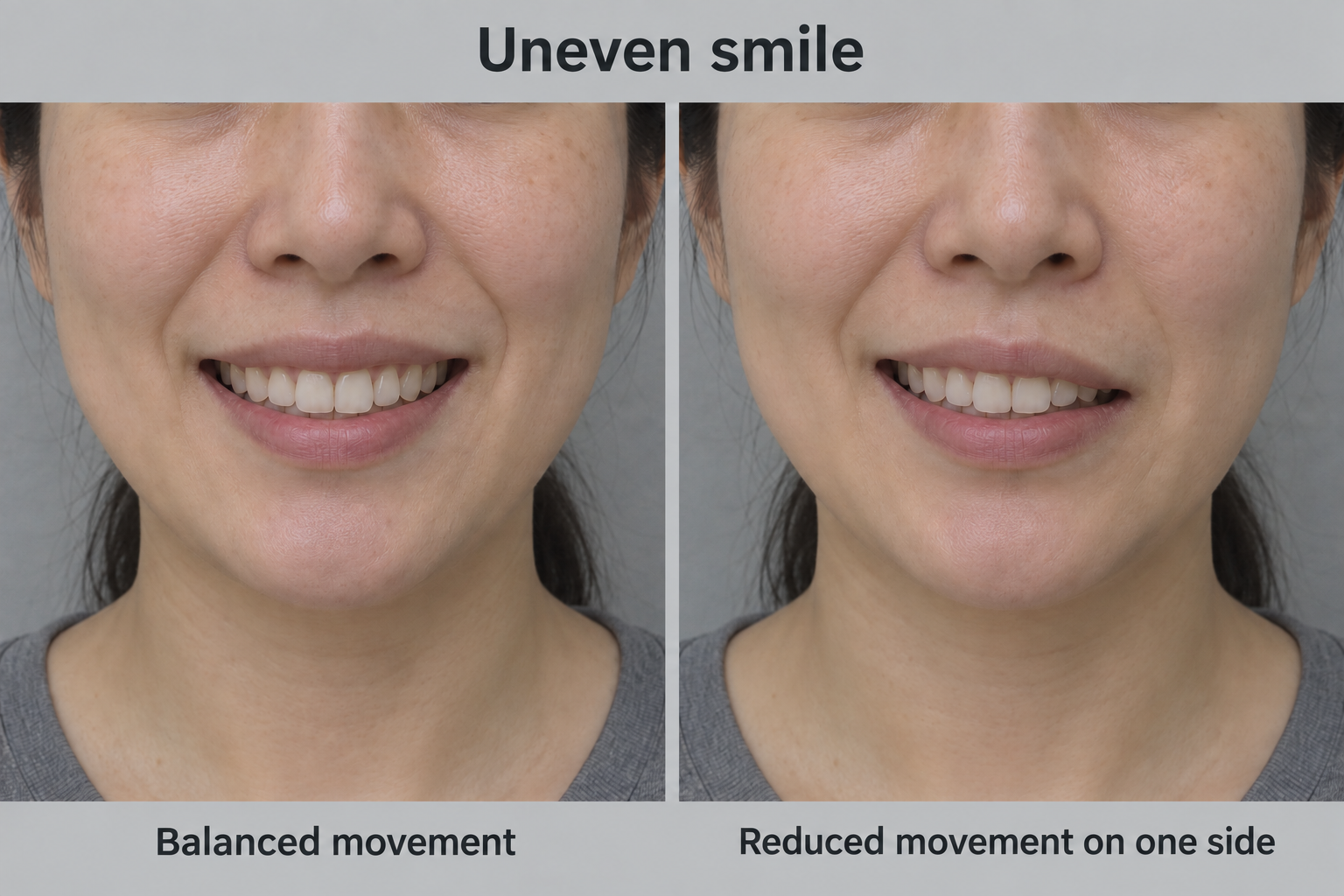
Tell your clinician when the change started and whether it appears only when smiling. Before-and-after photographs or short videos can help. A smile change is a reason to reassess, not an automatic reason to add more toxin.
Why is there a lump when I clench after jaw Botox?
This can be paradoxical masseter bulging, sometimes called a “candy-ball” appearance in Korea. Some muscle regions remain more active than others, producing a visible bulge during clenching.
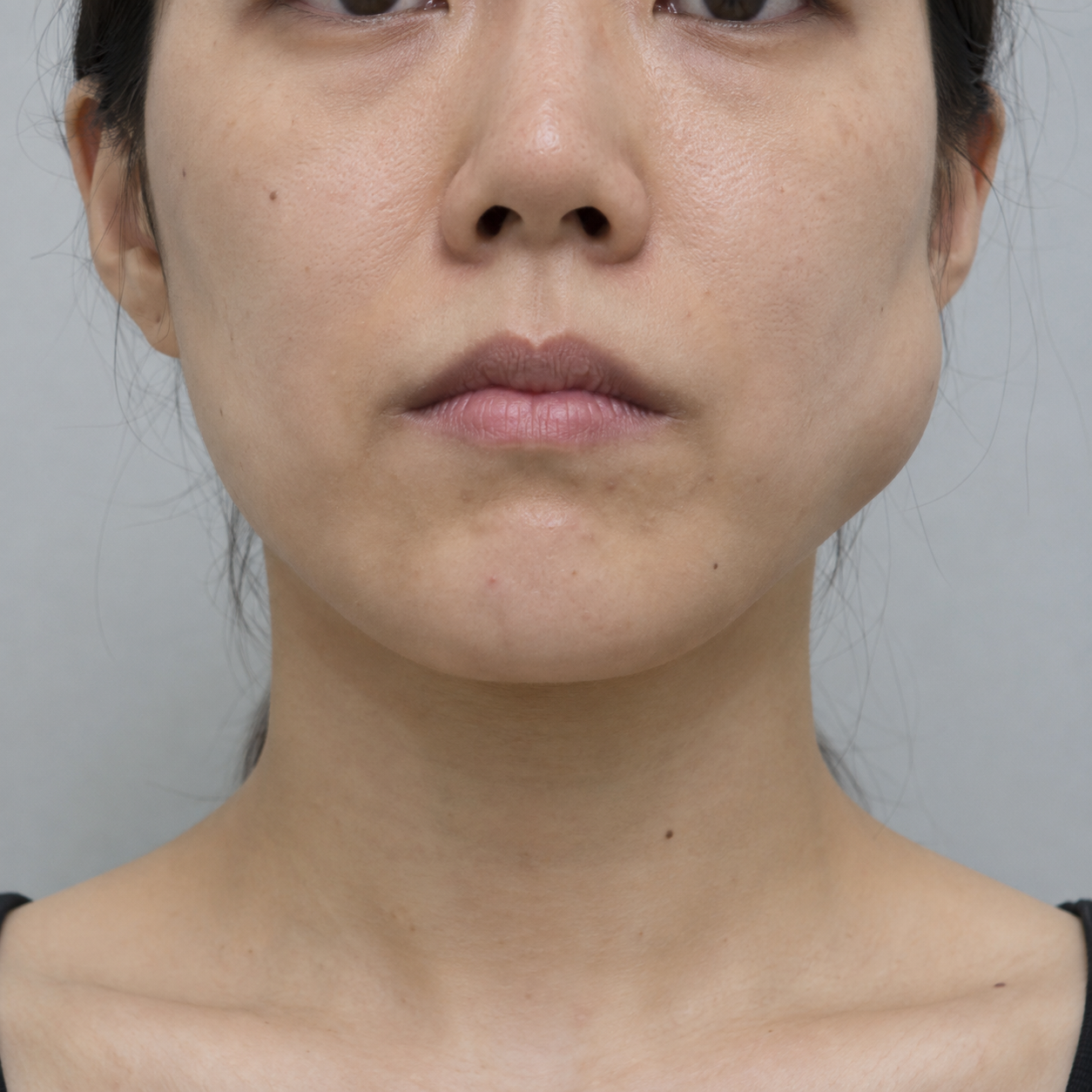
The masseter contains layers and internal tendons. A six-patient ultrasound study showed that deeper active compartments can contribute, so the explanation is not always “the superficial layer was missed.” It was a small case series, not a comparison proving the best treatment.
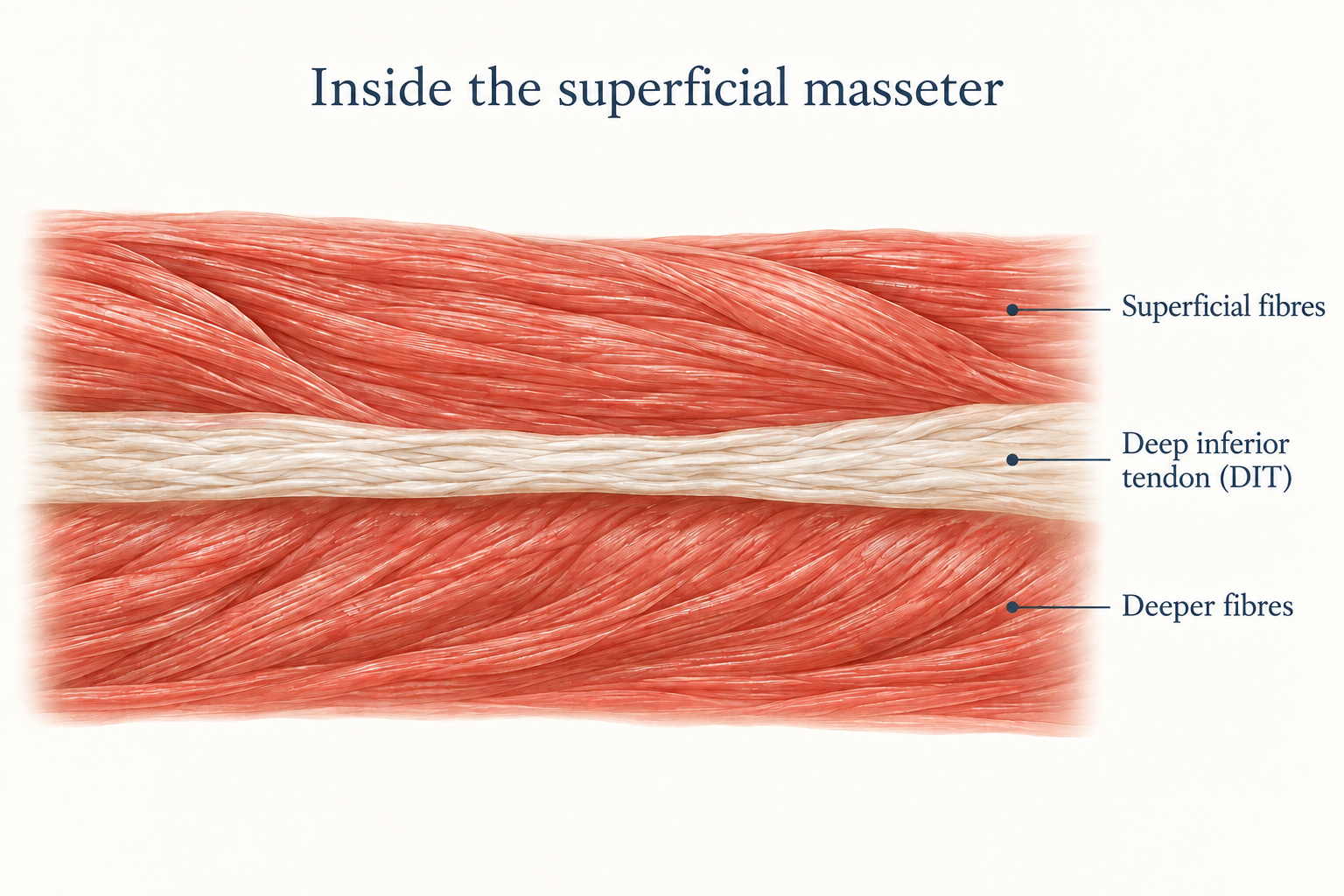
After confirming the cause, a clinician may consider a small, targeted correction. Published clinical guidance describes this approach, but more toxin is not appropriate for every lump or asymmetry. Ultrasound can be useful when the active region is unclear.
Can masseter Botox cause sunken cheeks or jowls?
It can change facial proportions enough to make hollowing or skin laxity more noticeable. Reducing muscle volume is the intended effect, but the amount that looks balanced differs between faces. Existing hollows, prominent cheekbones, limited soft-tissue volume, and skin laxity matter.
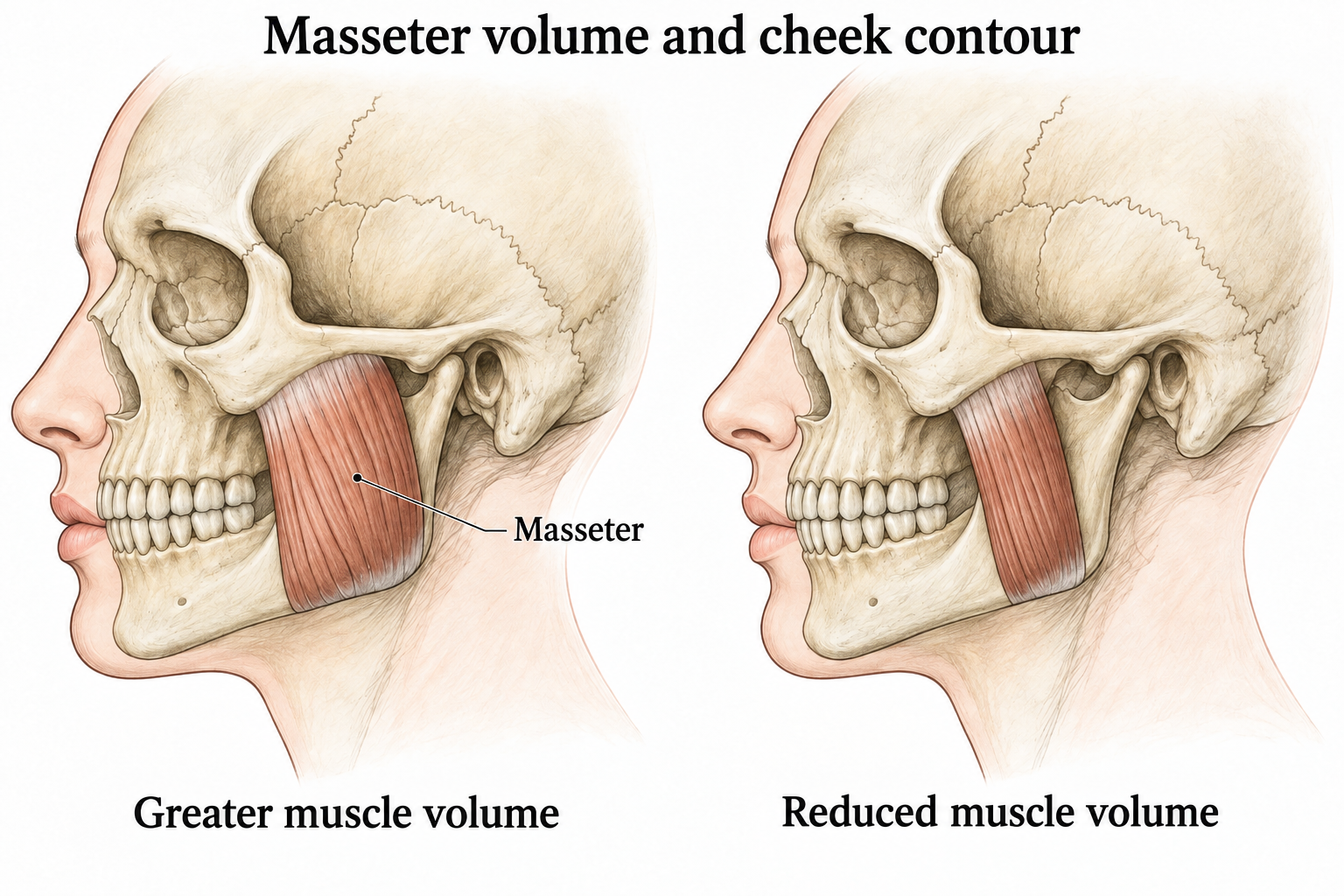
As discussed in a review of masseter treatment and complications, the surrounding facial shape matters. Sunken cheeks and jowls are different: one describes a hollow, the other sagging along the lower face. Botox is not a cheek-fat dissolving treatment, and it is not a skin-tightening treatment.
A prospective study of a modified injection approach reported no worsening of cheek hollowing among 43 patients reached at four weeks. The short follow-up and lack of a comparison group mean this is not a guarantee of prevention.
If your cheeks already look too hollow, pause plans for further slimming until you have been reassessed. Filler is not an automatic next step while the contour is still changing.
How long do masseter Botox side effects last?
Many local effects improve as the toxin’s action wears off, but there is no single recovery deadline. Smile movement, chewing strength, and muscle volume may recover at different rates. A three-month check can be useful, but it is not a promise that your face will be back to baseline then.
There is no established quick way to reverse an unwanted masseter Botox result. Warm compresses or radiofrequency should not be presented as proven fixes for an affected smile. For example, research on radiofrequency and toxin activity studied different treatment sequences around crow’s feet and in animals, not reliable reversal of this complication.
Bruising and tenderness can occur at injection sites. If chewing feels tiring, choose foods you can manage comfortably and contact the clinic if the problem affects eating. Do not force prolonged gum chewing to try to “work off” the treatment.
Get urgent medical help for trouble swallowing, speaking or breathing, or widespread weakness after a botulinum toxin injection. These symptoms differ from a cosmetic asymmetry. See the official BOTOX Cosmetic safety information.
Is Botox for teeth grinding different from Botox for jaw slimming?
The treatment goal changes the decision. For grinding or clenching, assessment focuses on symptoms and function. For cosmetic treatment, it focuses on muscle size and facial contour. Bruxism is not the same as every cause of jaw-joint pain.
| Purpose | How repeat treatment is considered |
|---|---|
| Grinding / clenching | Review recurrent symptoms and chewing function. Roughly 3–6 months is a practical range, not a fixed guideline. |
| Jaw slimming | Reassess around 6 months; wait longer if the contour remains satisfactory. |
The 3–6-month range appears in a Cochrane review protocol, not a completed review establishing an optimal schedule. In the cosmetic trial above, repeat treatment at six months depended on persistent marked muscle prominence.
Grinding may therefore prompt earlier review, but it does not automatically require a higher dose. A placebo-controlled sleep-bruxism trial found reduced contraction intensity through 12 weeks, without a significant reduction in grinding-event frequency; 23 of 30 participants completed follow-up. Botox should not be described as removing the underlying cause of grinding, and dental assessment remains relevant.
What should I ask before getting masseter Botox in Korea?
A short appointment does not mean the final result will be visible during a short trip. Cosmetic trials assess contour over months. Plan follow-up even if you expect little disruption to sightseeing.
- Is muscle actually the main cause of my jaw width? Ask the doctor to assess your face at rest, while clenching, and while smiling.
- Which product, and how many units on each side? Record the exact brand and formulation. Units are not interchangeable across products.
- What does the quote include? Clarify whether it covers both masseters, other muscles, review visits, and any proposed correction.
- How will we communicate after I leave? Confirm the consultation language, written aftercare, a contact route, and when local medical review would be needed.
- What should I disclose? Bring dates, products and doses from previous treatments, and mention prior smile changes, hollowing or chewing difficulty.
Ask about the exact product’s locally approved indications and whether the proposed use is off-label. Regulatory approval differs by product, indication and country. Read more about planning skin treatments around a trip to Korea.
Frequently asked questions
Does masseter Botox permanently slim the face?
It is not intended as a permanent treatment. Muscle-volume changes can outlast the initial weakening, so the return of stronger chewing does not automatically mean another injection is due.
How many units are safe?
There is no universal number that prevents side effects. Muscle size, asymmetry, existing facial volume, previous response and the exact product all matter. “50 units” is incomplete information without the brand and whether it means per side or in total.
Will more Botox fix an uneven smile?
Not necessarily. A restricted smile and a bulge during clenching have different mechanisms. Arrange an assessment before considering a correction.
Can I have a touch-up before flying home?
A departure date is not a reason to add treatment before the first result can be assessed. Agree on a review plan before treatment; some changes may become apparent after you have left Korea.
My priority is a balanced face that still feels like yours. Tell your doctor both what you want to change and what you want to preserve, whether that is cheek fullness, comfortable chewing, or your natural smile.
Your own, Dr. Youro
Related: Forehead Botox in Korea: heavy eyelids, ptosis and Spock brow.
References and evidence notes
Key clinical results below were checked against PubMed abstracts or accessible article text. Anatomy studies explain possible mechanisms; small case series do not establish complication rates or guarantee a correction. The bruxism protocol is not a treatment guideline.
- Bae JH, et al. The risorius muscle: anatomic considerations with reference to botulinum neurotoxin injection for masseteric hypertrophy. Dermatol Surg. 2014;40(12):1334–1339. PubMed. Anatomy study; abstract reviewed.
- Lin F, Roberts S, Magnusson M. Rethinking Paradoxical Bulging of the Masseter Muscle Following Botulinum Toxin Injection: An Ultrasound Evaluation. Aesthet Surg J Open Forum. 2025;7:ojae120. DOI. Six-patient case series.
- Rice SM, Nassim JS, Hersey EM, Kourosh AS. Prevention and correction of paradoxical masseteric bulging following botulinum toxin injection for masseter hypertrophy. Int J Womens Dermatol. 2021;7:815–816. DOI. Clinical report.
- Huang SL, et al. A Novel Injection Technique to Prevent Exacerbation of Sunken Cheek After Botulinum Toxin Type A Treatment for Masseter Hypertrophy: A Prospective Clinical Study. J Cosmet Dermatol. 2025;24(4):e70120. Article. Short, uncontrolled study.
- Carruthers J, et al. Reduction of masseter muscle prominence after treatment with onabotulinumtoxinA: Primary results from a randomized phase 2 study. J Am Acad Dermatol. 2025;92(3):464–472. PubMed. Abstract reviewed; manufacturer involvement and author conflicts disclosed.
- Shim YJ, et al. Botulinum Toxin Therapy for Managing Sleep Bruxism: A Randomized and Placebo-Controlled Trial. Toxins. 2020;12(3):168. PubMed. Abstract reviewed.
- Botulinum toxins for sleep bruxism. Cochrane Database Syst Rev. 2024;CD015010. Review protocol.
- Jiang L, et al. Does microneedle fractional radiofrequency system inactivate botulinum toxin type A? J Cosmet Dermatol. 2023;22(7):2008–2017. PubMed. Abstract reviewed; indirect evidence, not a masseter-complication reversal trial.
- Wu Y, Zeng D, Wu S. Botulinum Toxin Type A for the Treatment of Masseter Muscle Prominence in Asian Populations. Aesthet Surg J Open Forum. 2023;5:ojad005. Article. Narrative review, not a comparative trial.
Adapted for English-speaking readers from Dr. Youro’s Korean article on masseter Botox side effects. This article provides general education and does not replace an individual medical or dental assessment.


Leave a Reply