
By Youro Kang, MD, Dr. Youro, a licensed physician in South Korea
Thinking about forehead or frown-line Botox during a trip to Korea? Smoother lines are only part of the decision. Your eyebrows and eyelids still need to move comfortably.
Heavy eyes after Botox do not always mean eyelid ptosis. A lower brow, a drooping eyelid and an overly raised outer brow are different changes. The right response starts with identifying which structure has changed.
I’m Dr. Youro. For each symptom below, I’ll explain why it happens, how I tailor treatment to reduce the risk, and what to do if it develops, including after you return home.
In Korean clinic menus, forehead Botox usually refers to horizontal forehead lines, while glabellar Botox targets the frown lines, or “11s”, between your eyebrows. “Botox” is often used informally for different botulinum toxin products. Ask for the actual product name rather than assuming every clinic uses the same one.
1. Which muscles do forehead and frown-line Botox affect?
The frontalis is the main muscle that raises your eyebrows. When you look surprised, it lifts the brows and creates horizontal forehead lines. Reducing its activity can soften those lines, but can also reduce the support keeping your brows up.
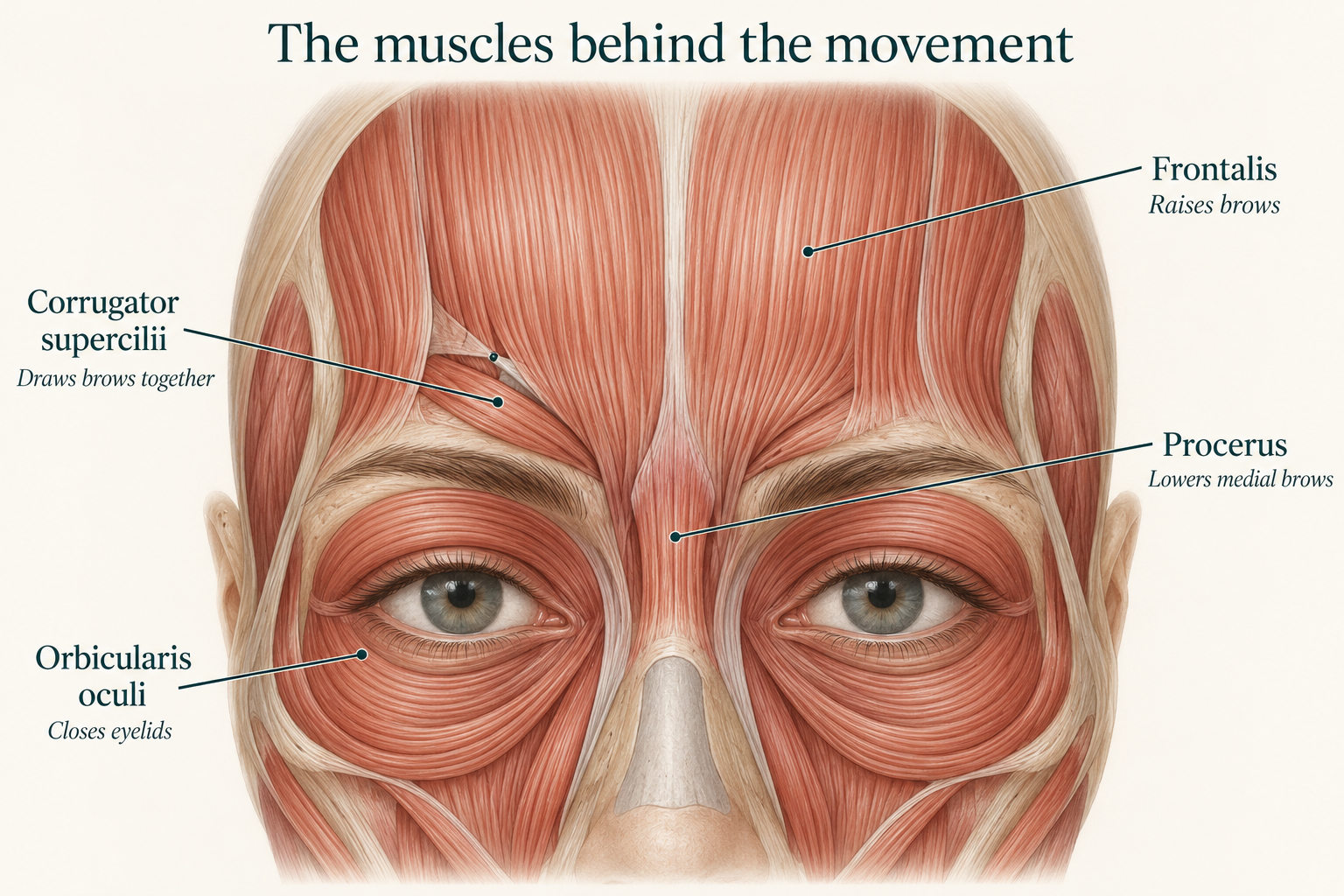
The corrugator supercilii draws the brows together. The procerus, over the bridge of the nose, helps pull the inner brows down. The orbicularis oculi surrounds the eye, closes the eyelids and also contributes to downward pull around the brow.
These muscles act together. A good assessment looks at the balance between lifting and lowering, rather than treating each wrinkle as an isolated line. This is a central point in the clinical review of frontalis function and glabellar treatment.
Find your symptom- Heavy eyes or a lower brow
- An overly raised outer brow
- A remaining crease or central bulge
- A drooping upper eyelid
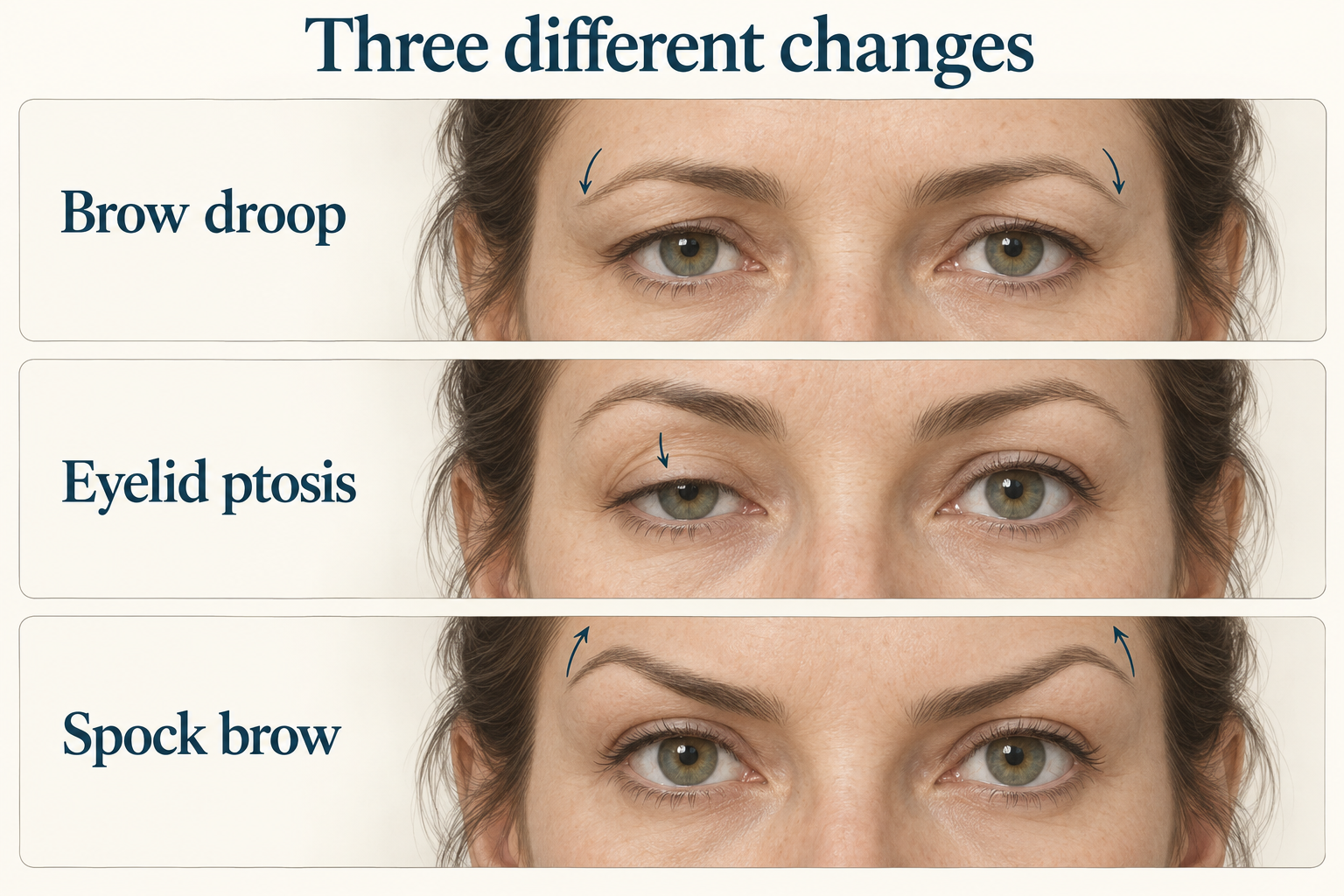
Look at what has changed: brow droop lowers the eyebrow; eyelid ptosis lowers the upper eyelid edge; Spock brow raises the outer eyebrow into a peak. “Heavy eyes” alone does not tell us which one is happening.
2. Why do my eyes feel heavy after forehead Botox?
Why it happens
Some people habitually recruit frontalis to help compensate for low brows or skin hooding above the eyes. They may not realise they are doing it until that muscle becomes weaker.
If the lifting force is reduced too much, the brows can sit lower and more skin can drape over the upper eyelids. Your eyes may feel heavy or look smaller even when the eyelid margin itself has not dropped.
How I reduce the risk
If someone relies on frontalis to help lift a low brow or hooded skin, I plan conservatively around the lower forehead. Depending on their movement pattern, I may position injections higher, adjust the dose, or use a shallow intradermal approach rather than routinely injecting deeply towards the bone. Height, depth and dose need to work together.
A small randomised study involving 29 women found better preservation of brow position with intradermal injections, but greater pain; eyebrow movement decreased in both groups. I reviewed its abstract. Shallow placement therefore does not mean that brow heaviness is impossible.
What to do if it happens
Contact the treating clinician rather than assuming that every heavy-feeling eye needs more Botox. Compare your brow position and eyelid edge with pre-treatment photographs. If the brow has dropped, further weakening the forehead can make the heaviness worse.
Once treatment-related brow weakness is confirmed, improvement generally follows the return of muscle activity. This may take weeks and sometimes longer; there is no guaranteed three-month deadline. The clinical management review distinguishes brow droop from true eyelid ptosis. Eye drops used for a low eyelid do not restore frontalis support to a low eyebrow.
Can warmth or radiofrequency speed things up? These are sometimes discussed as supportive measures, but I would not promise faster toxin “clearance” or a reliable reversal of brow heaviness. A 2025 review of eyelid-ptosis management mentions RF, but does not establish that RF or home warm compresses speed recovery from forehead-related brow droop. Do not try to heat away the effect with hot compresses, a sauna or a home device around the eyes.
3. Why has my outer eyebrow become pointed?
Why it happens
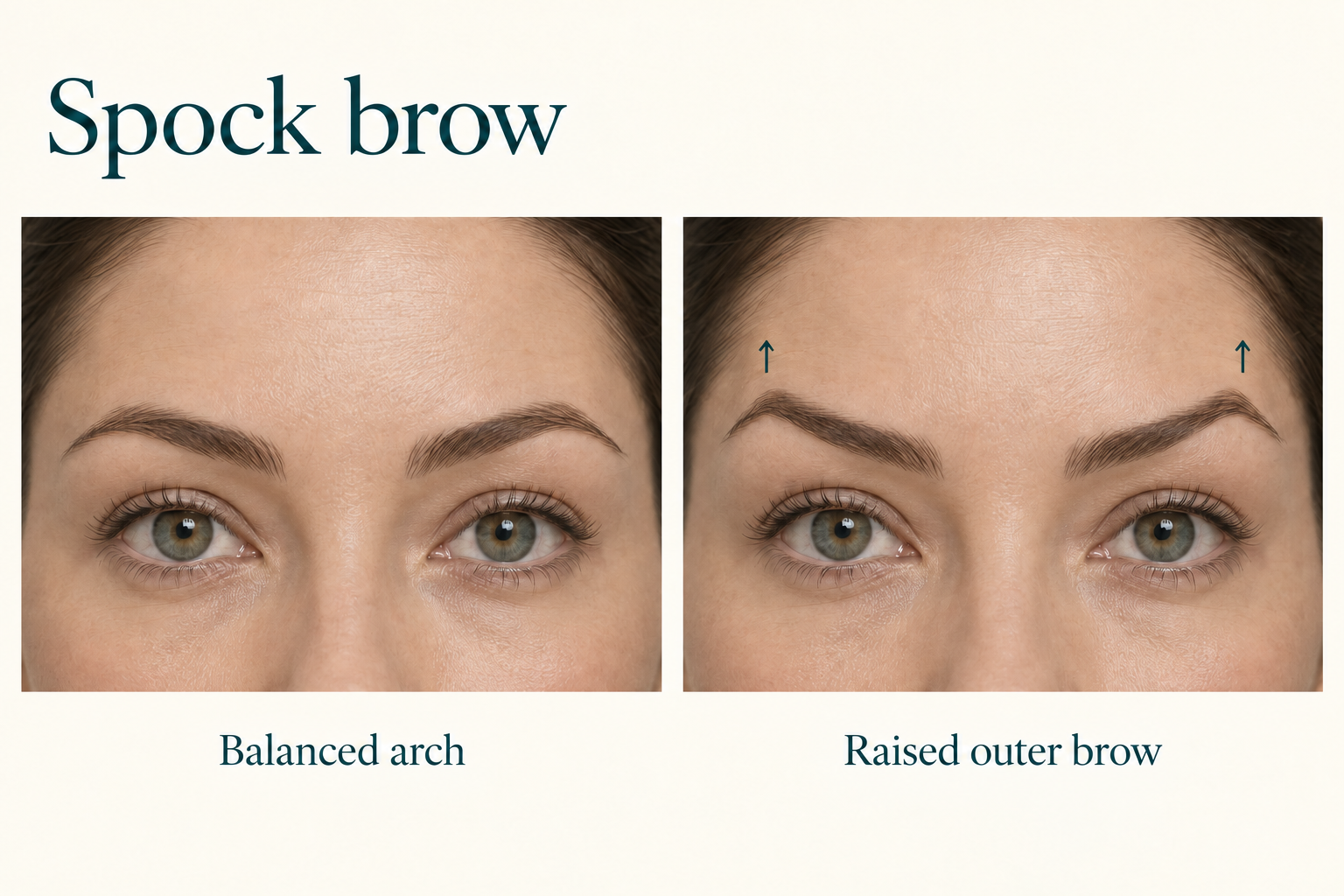
You may hear the same appearance called “samurai eyebrows” in Korea. The outer brow becomes unusually peaked while the centre looks relatively still.
One explanation is that the central frontalis has weakened more than its lateral fibres. The remaining outer lifting movement then becomes more obvious. This does not mean another muscle has suddenly grown larger.
How I reduce the risk
I pay attention to the outer frontalis as well as the centre of the forehead. This includes the area outside the midpupillary line, an imaginary vertical line through the centre of the pupil. My treatment plan accounts for that outer lifting action so it is not left disproportionately strong while the centre relaxes. Placement and dose still depend on the individual: weakening the outer forehead too much can lower the brow.
What to do if it happens
Spock brow can often be improved with a small, targeted adjustment. After checking the settled response, a clinician may treat residual lateral frontalis activity outside the midpupillary line to soften an exaggerated outer-brow peak. Improvement develops as the added toxin takes effect, rather than immediately.
A practical review of upper-face complications describes this selective correction. The aim is to balance the remaining movement, not to repeat the whole forehead treatment.
Extra toxin can worsen heaviness if the brow is already low. A top-up should follow an examination, not a photograph or a flight deadline alone.
4. Why is one forehead crease or bulge more noticeable?
Why it happens
If movement at the edges decreases but central or upper frontalis fibres remain active, a local crease or bulge can stand out more when you raise your brows. That does not necessarily mean that the muscle has suddenly grown. A wrinkle that is already etched into the skin at rest is a different issue.

How I reduce the risk
I watch the whole forehead while you raise your eyebrows, including the upper and central areas. When appropriate, I distribute small amounts across selected sites within the planned total dose, rather than concentrating treatment in one area. The goal is balanced movement while preserving useful brow support.
A review of forehead movement discrepancies emphasises individual anatomy and treatment planning. Its PubMed abstract was reviewed; it does not prove that one injection pattern works for everyone.
What to do if it happens
Show the clinician what changes at rest and when you raise your brows, ideally alongside pre-treatment photographs. Once the initial response has settled, a local adjustment may be considered if residual muscle activity is the cause. A remaining line alone is not a reason to add toxin across the entire forehead. A new painful, red or enlarging lump needs an assessment rather than being assumed to be a movement imbalance.
5. What causes a drooping eyelid after frown-line Botox?
Why it happens
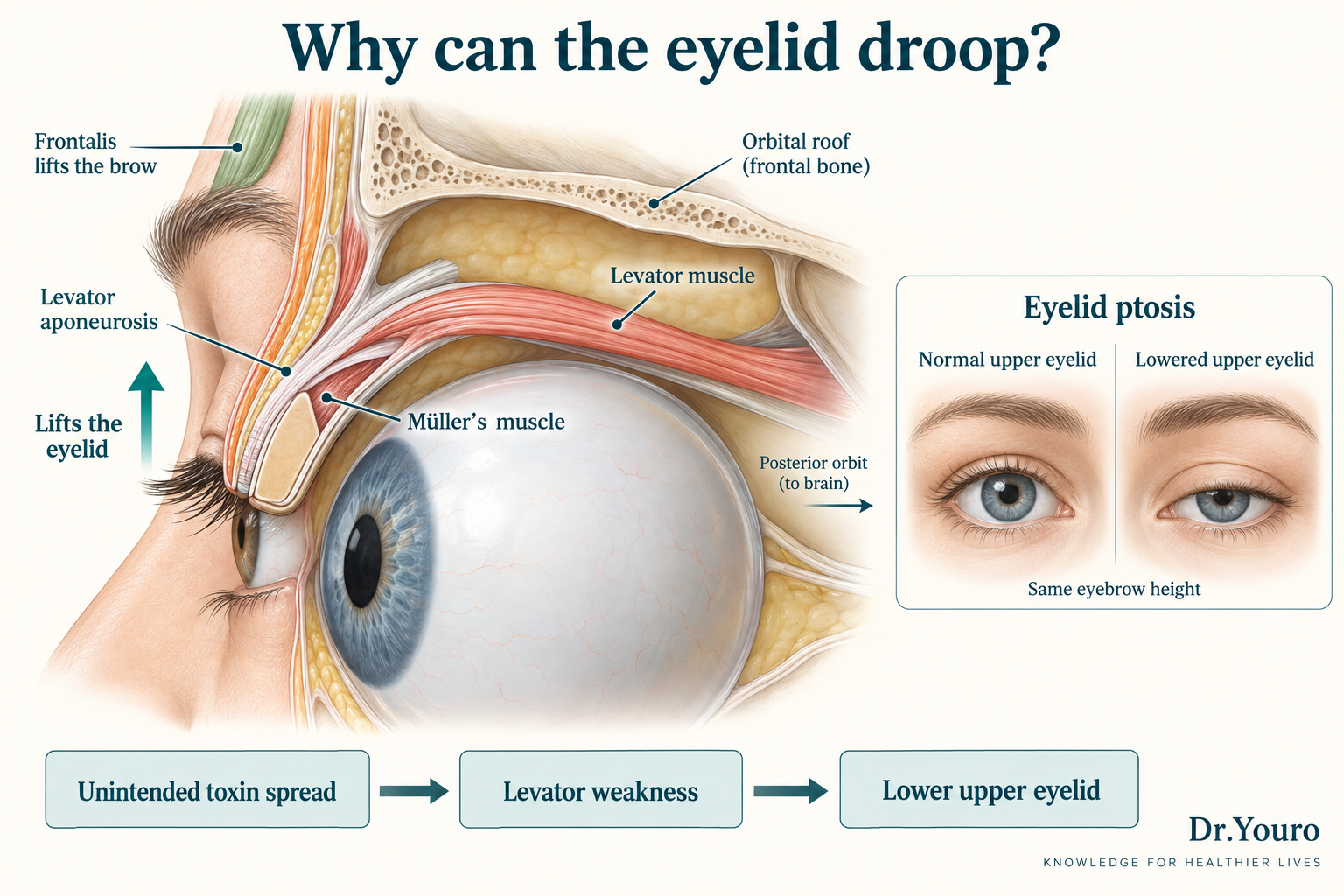
The main upper-eyelid elevator is the levator palpebrae superioris, often shortened to levator or LPS. It lies inside the orbit and transmits force to the lid through its aponeurosis, a sheet-like tendon. It is distinct from frontalis, which raises the brow.
Müller’s muscle, also called the superior tarsal muscle, makes a smaller contribution to upper-eyelid elevation. This is relevant when discussing certain prescription eye drops.
Unintended toxin spread to the levator can weaken eyelid elevation and cause ptosis. A review of botulinum toxin-related ptosis describes onset commonly around 3–14 days after injection. Timing alone, however, does not establish the diagnosis.
How I reduce the risk
When treating corrugator supercilii, I check that the needle is directed away from the orbit, the space containing the eye. I use a bevel-up orientation and support the supraorbital rim, the bony upper edge of the eye socket, with my other hand. The pressure is on the bone, not the eyeball.
The ptosis prevention review describes directing the needle away from the orbit and using finger pressure over the rim. Bevel orientation is a separate detail, however, and bevel-up placement alone has not been established to prevent ptosis. These precautions support careful site, depth and dose selection; they do not create a complete barrier against toxin spread.
What to do if it happens
Have the eyelid position assessed, with an eye specialist involved when appropriate. A new droop should not automatically be blamed on Botox. Recovery can occur within weeks, but some cases last months. The duration of the unwanted weakness is not necessarily the same as the duration of wrinkle reduction.
Apraclonidine can temporarily raise the eyelid by stimulating Müller’s muscle. It does not remove toxin or restore a lowered eyebrow. Suitability, eye history, medication interactions and adverse effects need review by a clinician. Availability and prescribing rules differ by country. See the ptosis treatment review.
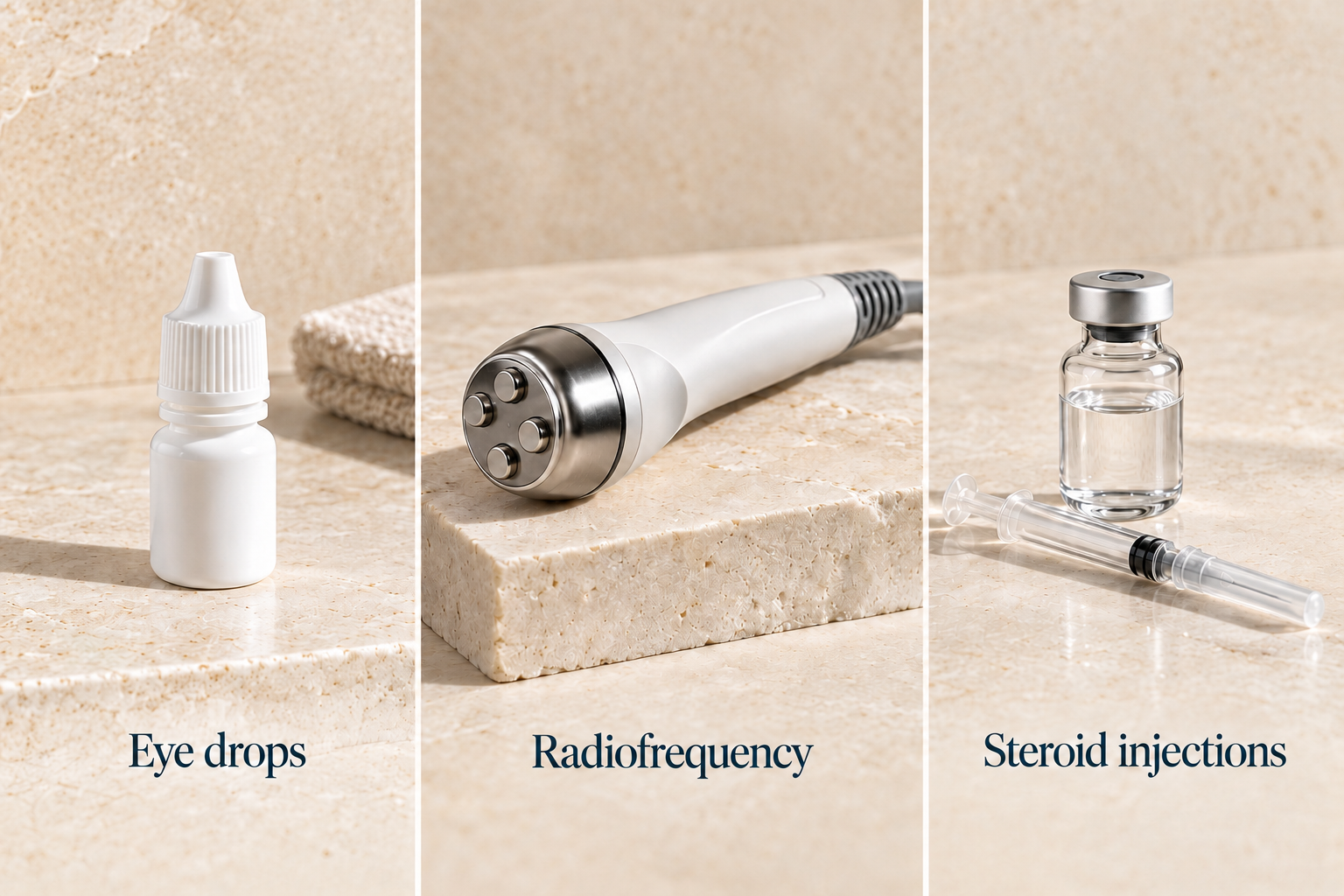
RF is an uncertain adjunct. It appears in the 2025 management review, which acknowledges scarce evidence and a small clinical experience. That is not proof that RF reliably shortens toxin-related ptosis. Treatment near the eye needs specialist assessment of the device, site and risks.
Steroid injections are not an established antidote. Dexamethasone or betamethasone injections have not been established as routine reversal treatment. A 2005 case report used a steroid-antibiotic eye-drop combination with apraclonidine, not a steroid injection into the affected muscle. Only the abstract was reviewed, and a single combined-treatment case cannot show which component caused improvement.
Relieving discomfort and reversing the toxin are different goals. First establish whether the problem is brow position, eyelid elevation, the ocular surface, or a combination.
6. What if symptoms appear during my trip or after I return home?
For travellers, the practical implication is simple: a normal-looking result on the day of treatment does not exclude a problem developing after departure. Agree on a follow-up contact before leaving the clinic.
Contact the treating clinician and describe when the change started, whether one or both eyes are affected, and any visual symptoms. Keep photographs taken in similar lighting, both at rest and while gently raising your brows.
If you are already home, ask the Korean clinic for your treatment record and arrange a local assessment when needed. An online message can help with follow-up, but cannot replace an eye examination.
Seek prompt medical assessment for eye pain, reduced vision, double vision or difficulty closing the eye. Sudden severe visual symptoms need urgent care rather than waiting for a routine review.
Eye closure and the tear film also matter. The review of periocular toxin and the ocular surface explains why changes around the eye can affect blinking and dryness.
7. Planning forehead Botox during a Korea trip

A short appointment does not mean the full response will be visible before your flight. Bring your departure date and important events into the consultation.
- Discuss previous problems. Mention heavy brows after earlier treatment, eyelid surgery, existing asymmetry and dry-eye symptoms.
- Ask for a movement assessment. Resting photographs alone do not show how much you rely on frontalis when opening your eyes.
- Agree on a review plan. Response is often reassessed around two weeks, depending on the product and individual. This is not a guaranteed recovery period or an automatic top-up date.
- Confirm communication. Ask which language is available for consent and aftercare, how to contact the clinician from abroad, and where to seek local care if symptoms develop.
- Keep the details. Take the treatment date, product name, treated areas, dose if available, clinic contact and an itemised receipt.
If your trip ends before a useful review can happen, discuss whether to change the timing or defer treatment. The goal is a workable care plan, not squeezing in every available procedure.
For more planning questions, read Botox in Korea: timing, brands and follow-up. If a clinic offers “skin Botox” instead, see how skin Botox differs from conventional wrinkle treatment.
Quick questions
Does everyone need forehead and glabellar Botox together?
Both areas should be assessed together, but the same treatment pattern does not suit everyone. Brow position, muscle activity and your goals guide the plan.
Does a remaining forehead line mean I need more?
No. Preserving some frontalis movement may help maintain comfortable brow support. A line etched into the skin at rest may also persist despite reduced muscle activity.
Can I get a correction just before flying home?
A departure date is not a reason to rush. Contact the clinician if a problem appears, then decide whether any adjustment is appropriate and how its response will be reviewed.
Will the effect definitely be gone in three months?
No exact recovery date can be guaranteed. Have the cause assessed and follow the agreed review plan, especially if symptoms persist, worsen or affect vision.
Tell me what felt uncomfortable after previous treatment, even if it seemed minor. Those details help shape the next plan. My aim is to soften lines while preserving comfortable eye opening and natural expression. Careful technique can reduce risk, but cannot eliminate it.
My takeaway: a successful forehead treatment is about more than fewer wrinkles. It should respect the muscles you need to support your brows and open your eyes comfortably.
Your own, Dr. Youro
Research and further reading
- Bertucci V et al. Integrative Assessment for Optimizing Aesthetic Outcomes When Treating Glabellar Lines With Botulinum Toxin Type A: An Appreciation of the Role of the Frontalis. Aesthetic Surgery Journal. 2023;43(Suppl 1):S19–S31. Read the article. Expert clinical assessment review.
- Nestor MS et al. Botulinum toxin-induced blepharoptosis: Anatomy, etiology, prevention, and therapeutic options. Journal of Cosmetic Dermatology. 2021. DOI. Review; some treatment evidence is limited to small reports.
- Zargaran D et al. Complications of Cosmetic Botulinum Toxin A Injections to the Upper Face: A Systematic Review and Meta-Analysis. Aesthetic Surgery Journal. 2022;42(5):NP327–NP336. DOI. Definitions and reporting varied across studies; results are not an individual risk prediction.
- Ho RW et al. A Review of Periocular Botulinum Neurotoxin on the Tear Film Homeostasis and the Ocular Surface Change. Toxins. 2019;11(2):66. DOI.
- Management of Ptosis. Journal of Clinical and Aesthetic Dermatology. 2016. Read the article.
- Omoigui S, Irene S. Treatment of ptosis as a complication of botulinum toxin injection. Pain Medicine. 2005;6(2):149–151. PubMed abstract. Single case report, not evidence for steroid injections as routine reversal.
- Kim YJ, Lim OK, Choi WJ. Are There Differences Between Intradermal and Intramuscular Injections of Botulinum Toxin on the Forehead? Dermatologic Surgery. 2020;46(12):e126–e131. PubMed abstract. Small randomised comparison involving 29 women; abstract reviewed.
- Walker B, Hand M, Chesnut C. Forehead Movement Discrepancies After Botulinum Toxin Injections: A Review of Etiology, Correction, and Prevention. Dermatologic Surgery. 2022;48(1):94–100. PubMed abstract. Review; abstract reviewed.
- Rengifo-Palacios JA et al. Iatrogenic Blepharoptosis: Multimodal Management and Treatment Technique With Botulinum Toxin Type A. Dermatology Research and Practice. 2025;2025:8827594. Full text. Review and limited clinical experience, not a controlled test of RF or warm compresses.
- Borba A, Matayoshi S, Rodrigues M. Avoiding Complications on the Upper Face Treatment With Botulinum Toxin: A Practical Guide. Aesthetic Plastic Surgery. Published online 2021. DOI. Clinical review.
Adapted for international visitors from my Korean article. Medical information reviewed 5 October 2026. Illustrations explain concepts and do not show an individual patient’s treatment outcome. This article supports, but does not replace, an individual clinical assessment.


Leave a Reply