
By Youro Kang, MD · Dr. Youro
Korean doctor · Aesthetic medicine
You have booked Ultherapy in Seoul—but your flight leaves next week. Will the result be visible before you leave?
Ultherapy’s manufacturer guidance describes visible change at about three months. Clinical research also commonly measures outcomes at 90 and 180 days—not just immediately after treatment.
An Ultherapy results timeline
| When | What the mirror can tell you |
|---|---|
| Day 1 to the first weeks | Early tightening may be noticed, but redness or swelling can change appearance. It is too early to judge the lasting outcome. |
| Around months 2–3 | A useful point for a planned progress review. Visible change may be subtle and depends on the starting anatomy and treatment. |
| Around months 3–6 | Compare consistent photos and review the result with your clinician. A 180-day study found improvement in some—not all—patients. |
| Beyond that | Duration varies with ageing and the initial response. Discuss maintenance individually; do not treat a calendar date as an automatic reason to repeat. |

Why does skin tightening take months?
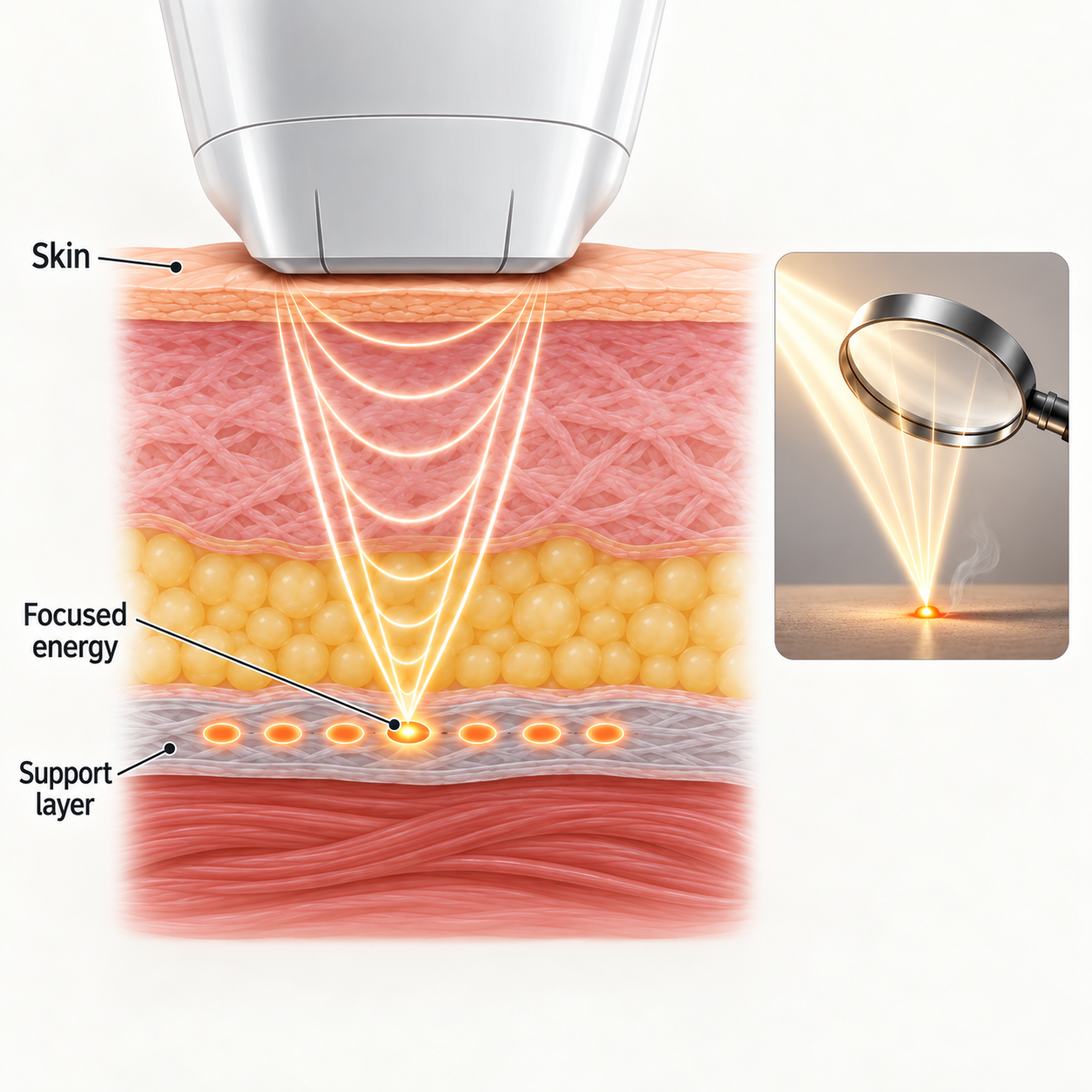
Microfocused ultrasound creates small, targeted zones of heat below the surface. The tissue response and collagen remodelling develop over time. That process differs from the immediate volume change produced by a filler.
In a prospective, nonrandomised Ulthera study, 103 adults enrolled and 93 were evaluated; blinded reviewers saw improvement in 58.1% at 90 days. The finding supports gradual, variable benefit—not a guaranteed facelift. Oni et al., 2014.
What about Shurink, Thermage and Oligio?
Korean clinic menus often group them under “lifting,” but they are different devices. Shurink uses focused ultrasound; Thermage and Oligio use radiofrequency. Model, tip, energy delivery and the treated area matter.
| Treatment | A sensible expectation |
|---|---|
| Ultherapy | A review around three months, sometimes again around six months, fits commonly studied time points. |
| Thermage | Manufacturer guidance describes gradual change over two to six months. Thermage information. |
| Shurink / Oligio | Ask for the expected timeline and evidence for the exact model used. Ultherapy or Thermage figures do not prove identical results for these devices. |
If your main concern is volume loss, heavy skin excess or a different cause of facial contour change, more energy may not solve it. Assessment matters more than choosing the largest shot count. Compare Korea’s skin-tightening options before deciding.
Can I travel while the result develops?
You do not need to stay in Korea for months simply to see the cosmetic result. You do need an aftercare plan, access to review and advice about your own travel timing.
Ultherapy can allow a quick return to routine activities, while tenderness or bruising persists. The device instructions describe swelling, bruising, sensory changes and other possible complications. Severe or worsening pain, blistering, new weakness or troubling numbness deserves prompt review—not waiting for the three-month photo appointment.
How to judge the result fairly
- Take baseline photos before treatment, then repeat at the agreed review points.
- Use the same lighting, camera distance, head position and facial expression.
- Record weight changes and other treatments that may alter the comparison.
- Discuss the amount of change you hoped for before paying—not only how long it lasts.
Quick answers
No result after two weeks: has it failed?
Not necessarily. Two weeks is earlier than common research assessment points. Ask your clinician about concerns, but avoid rushing into another energy treatment just to meet your departure date.
Can I get it right before a wedding?
Build in both recovery time and the slower cosmetic-response period. A new treatment shortly before an important event makes the appearance on that day harder to predict.
Read the research & references
Studies support modest improvement in selected patients, but use different settings and assessment methods. They cannot predict your exact timeline.
- Contini M et al. A Systematic Review of the Efficacy of Microfocused Ultrasound for Facial Skin Tightening. Int J Environ Res Public Health. 2023;20:1522. DOI: 10.3390/ijerph20021522. The review emphasises variability and the need for more objective studies.
- Oni G et al. Evaluation of a microfocused ultrasound system for improving skin laxity and tightening in the lower face. Aesthet Surg J. 2014;34:1099–1110. DOI: 10.1177/1090820X14541956. Prospective study without a randomised untreated comparator; assessment at 90 days.
- Fabi SG, Goldman MP. Retrospective evaluation of micro-focused ultrasound for lifting and tightening the face and neck. Dermatol Surg. 2014;40:569–575. DOI: 10.1111/dsu.12471. 48 women enrolled; 45 assessed at 180 days, 16 at 90 days. Unequal follow-up groups limit comparisons.
- Ulthera System Instructions for Use: adverse events and precautions


Leave a Reply