Hello, I’m Dr. Youro, a doctor in Korea. If you have been browsing Korean clinic menus, you may have noticed Botox listed for wrinkles, jaw slimming, skin texture and even salivary gland contouring. How can one type of medicine do such different things?
The shared action is reduced release of acetylcholine, a chemical messenger. The result depends on the tissue receiving that message: muscle contracts less, while a salivary gland receives less stimulation to produce saliva. Skin Botox uses superficial microinjections, with different goals and less consistent evidence.
Let’s look at those differences, and what they mean if you are considering treatment during a trip to Korea.
1. What does Botox actually do to a nerve signal?
Acetylcholine is stored in tiny packets inside nerve endings. To release it, a packet must fuse with the nerve cell’s outer membrane. A group of proteins called the SNARE complex helps bring the membranes together, rather like a zipper.
Botulinum toxin type A acts inside the nerve ending and cleaves SNAP-25, one component of that machinery. Less messenger is released. This does not mean the nerve is surgically cut, or that the medicine dissolves muscle or fat. Official product information, section 12.1.
Botox is often used casually as a category name, but BOTOX is a particular brand. Ask which botulinum toxin product a clinic proposes to use. Units are not automatically interchangeable between products.
Inside the molecule: two chains, three jobs
The active neurotoxin is approximately 150 kDa: a 100 kDa heavy chain helps it bind and enter nerve endings; a 50 kDa light chain performs enzymatic cleavage. A disulphide bond connects them.
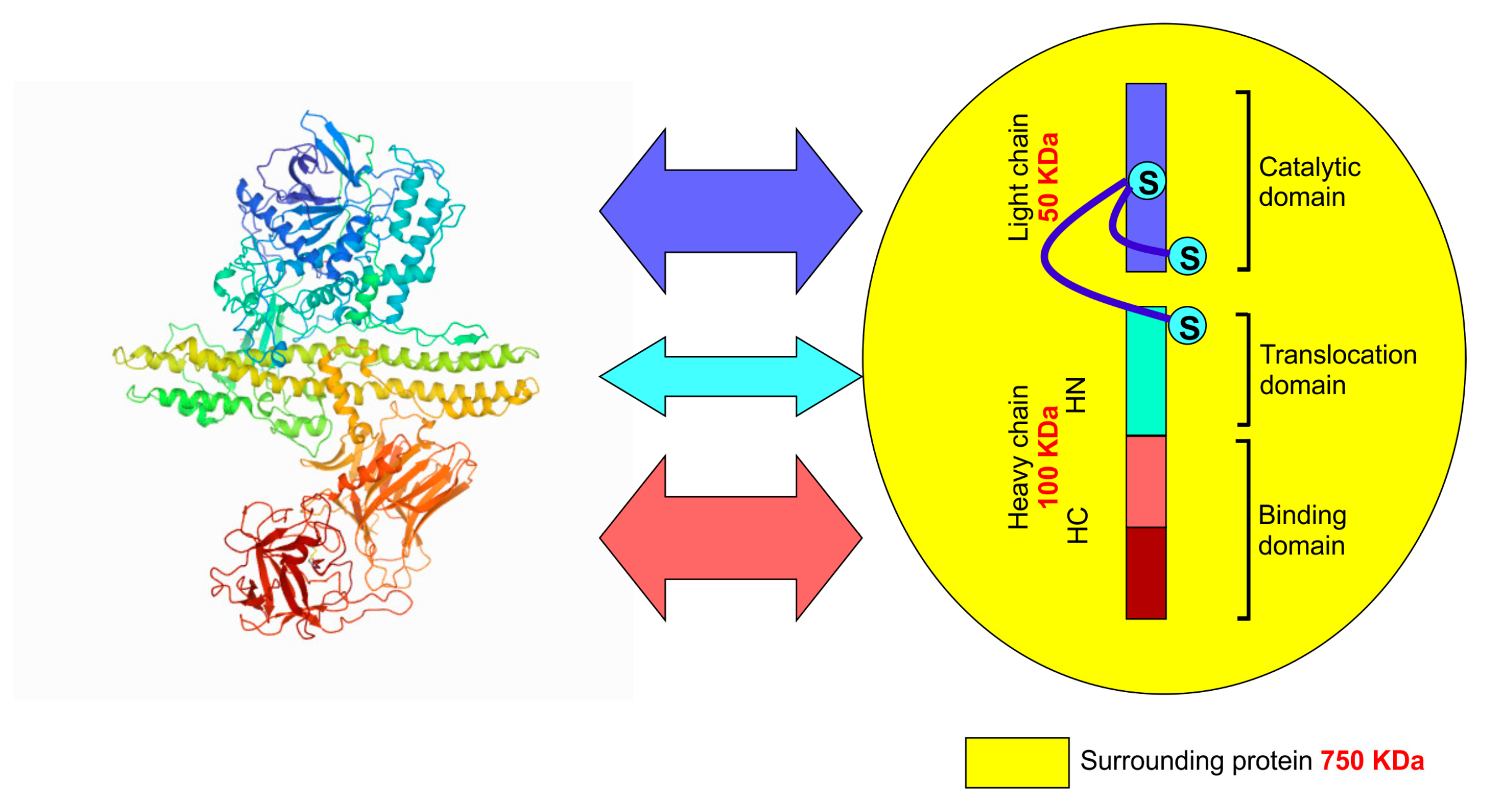
Protein structure, not an injection map. The ribbon model uses crystal structure PDB 3BTA. The yellow 750 kDa surrounding-protein label depicts one complex, not every commercial formulation. Choudhury, Baker, Chatterjee & Kumar, Toxins (2021), Figure 1, CC BY 4.0. Reproduced unchanged. View full-size image.
From nerve binding to reduced messenger release
Follow the sequence from binding and uptake to light-chain entry into the cytoplasm. For type A, the key target is SNAP-25: cutting it interferes with vesicle fusion and acetylcholine release.
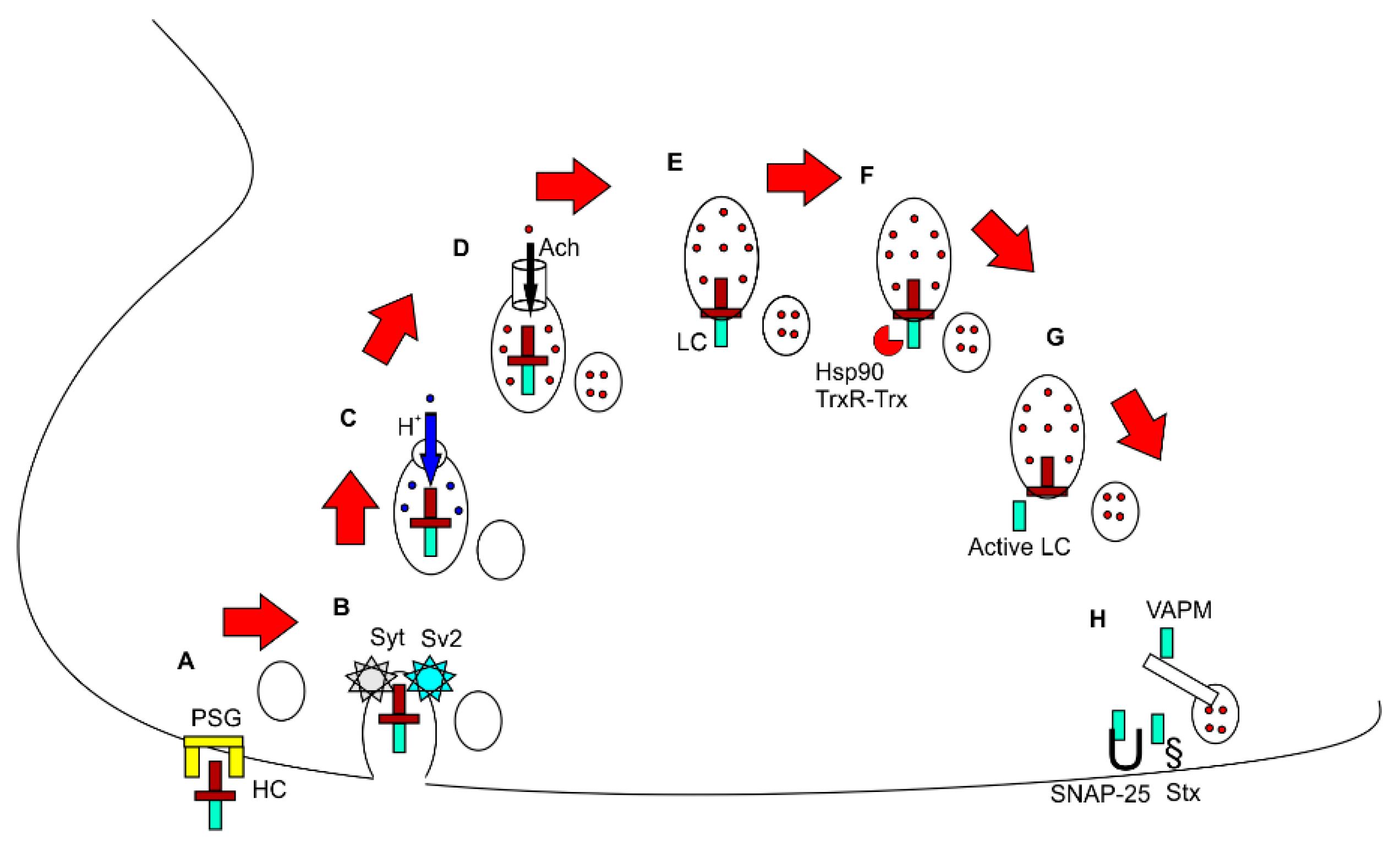
A closer view of the nerve terminal. This is a general multi-serotype diagram; type A does not cleave all three proteins shown. “VAPM” in the original means VAMP. Choudhury, Baker, Chatterjee & Kumar, Toxins (2021), Figure 2, CC BY 4.0. Reproduced unchanged. View full-size image.
2. Why do wrinkle Botox and muscle slimming work differently?
Expression lines: less pulling on the skin
Frowning, raising your eyebrows and tightening your chin fold the overlying skin. Reducing activity in the relevant facial muscles can soften movement-related lines. The initial improvement does not require the muscle to become visibly smaller first.
A crease that remains when your face is relaxed also reflects changes in the skin and underlying tissues. It may not disappear with toxin alone. Further treatment should follow an assessment of the cause.
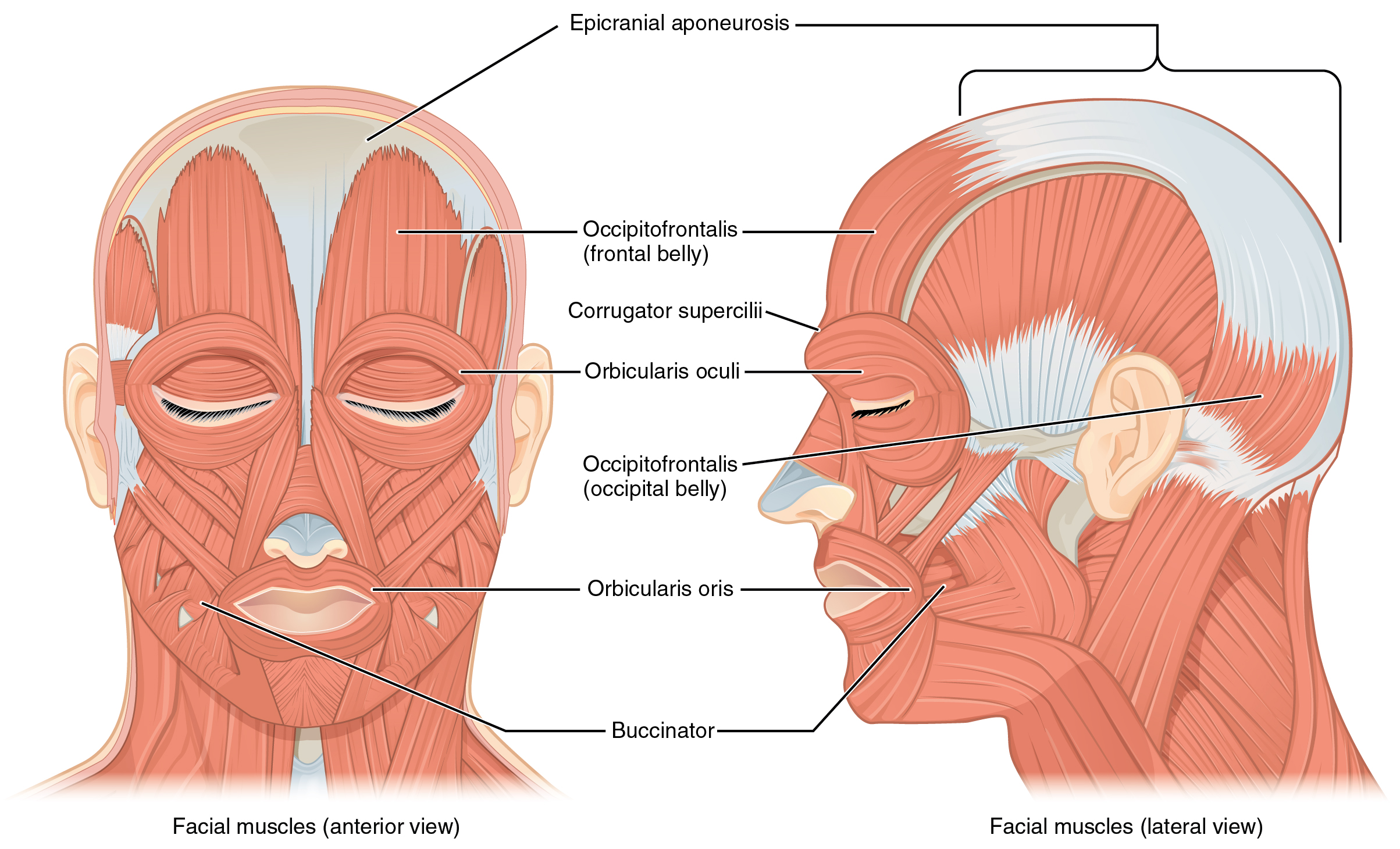
Which muscles fold the skin? Find the frontalis over the forehead, corrugator near the inner eyebrow, and orbicularis oculi around the eye. They move skin in different directions, which helps explain why treatment must preserve the balance of expression. OpenStax, source image, CC BY 4.0. Labels and artwork unchanged. View full-size image.
Muscle contouring: size changes take longer
The masseter is a chewing muscle at the side of the jaw. With reduced activation, treated muscle fibres may gradually become thinner. A change in strength and a visible change in contour are different outcomes, on different timelines.
A placebo-controlled phase 2b masseter study treated 145 adults and assessed prominence at day 90. Both active treatment groups improved more than placebo. This supports an effect in selected cases of prominent masseter muscles, rather than every cause of a broad lower face. Study summary.
The original Korean article also discusses the upper trapezius at the shoulders and the gastrocnemius in the calves. These are functional muscles: reducing their activity may affect strength. Results cannot simply be transferred from a jaw study to the shoulders or legs.
Bone shape, fat, swelling and loose skin can also cause apparent fullness. Reducing a muscle is not always the right answer.
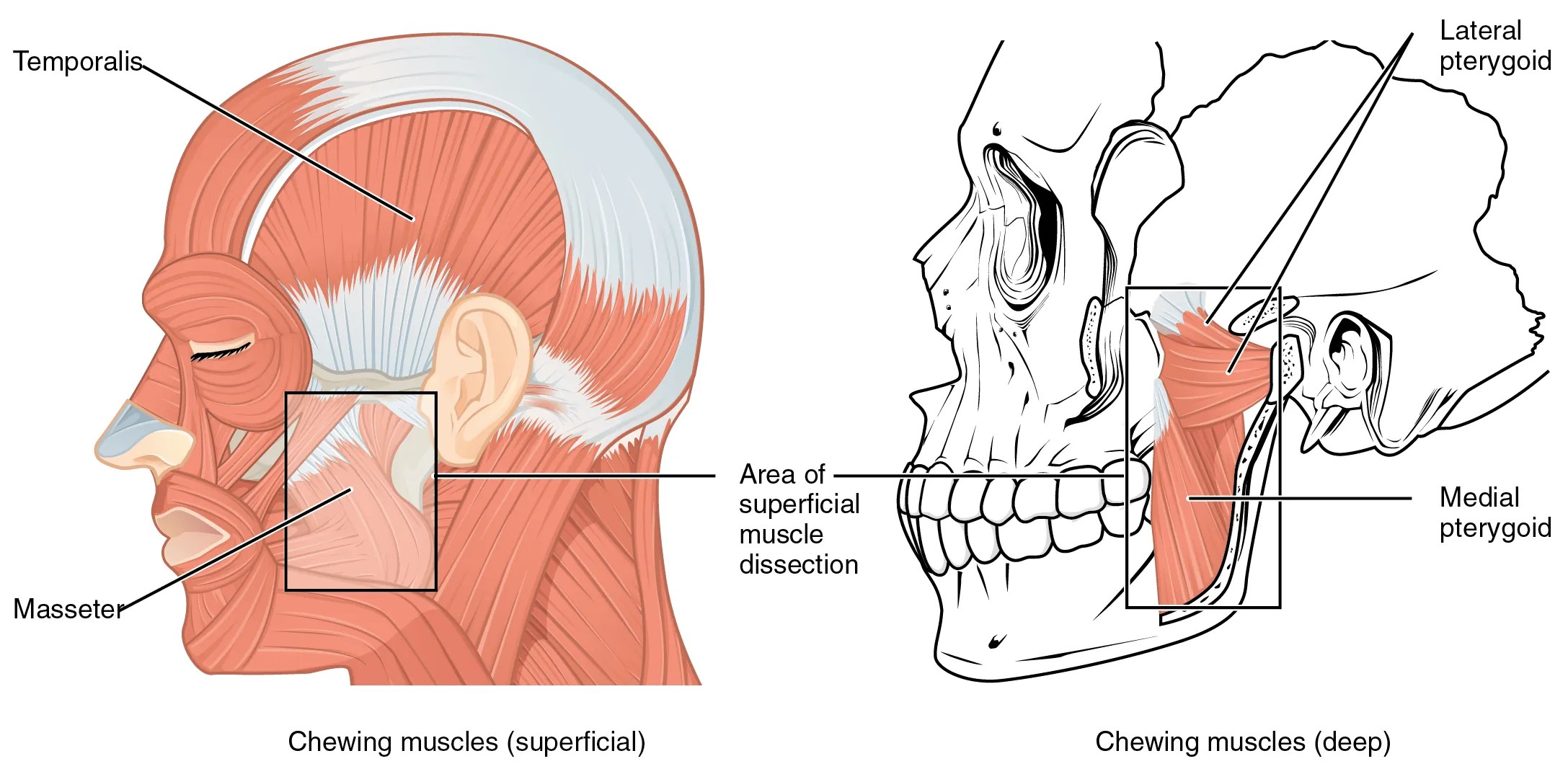
The masseter is a chewing muscle. It runs from the cheekbone region to the lower jaw. The temporalis and deeper pterygoids also participate in chewing. Jaw width is therefore not a diagnosis: bone, muscle, fat and gland tissue need to be distinguished. OpenStax, source image, CC BY 4.0. Labels and artwork unchanged. View full-size image.
3. What is Korean skin Botox?
Skin Botox generally means small, distributed injections into or close to the dermis, the deeper layer of skin. You may also see microbotox or mesobotox. These names do not describe one universally standardised protocol. Baby Botox may simply mean a lower-dose conventional treatment.
The goals may include softer fine lines, smoother texture and less visible oiliness or pores. Effects on superficial muscle fibres can contribute to changes in fine lines, but proposed skin and oil-gland mechanisms are more complex than the established neuromuscular action.
In a randomised, saline-controlled split-face study, 18 volunteers enrolled and 15 completed follow-up through 12 weeks. Some texture and fold measures improved, but sebum did not significantly improve and pore differences versus control were not significant. One participant developed facial weakness. A later correction clarified that the study used Coretox, not incobotulinumtoxinA. Study, correction.
Superficial does not mean expression-free. The medicine can still affect nearby facial muscles. Depth, location, dose and distribution all matter.
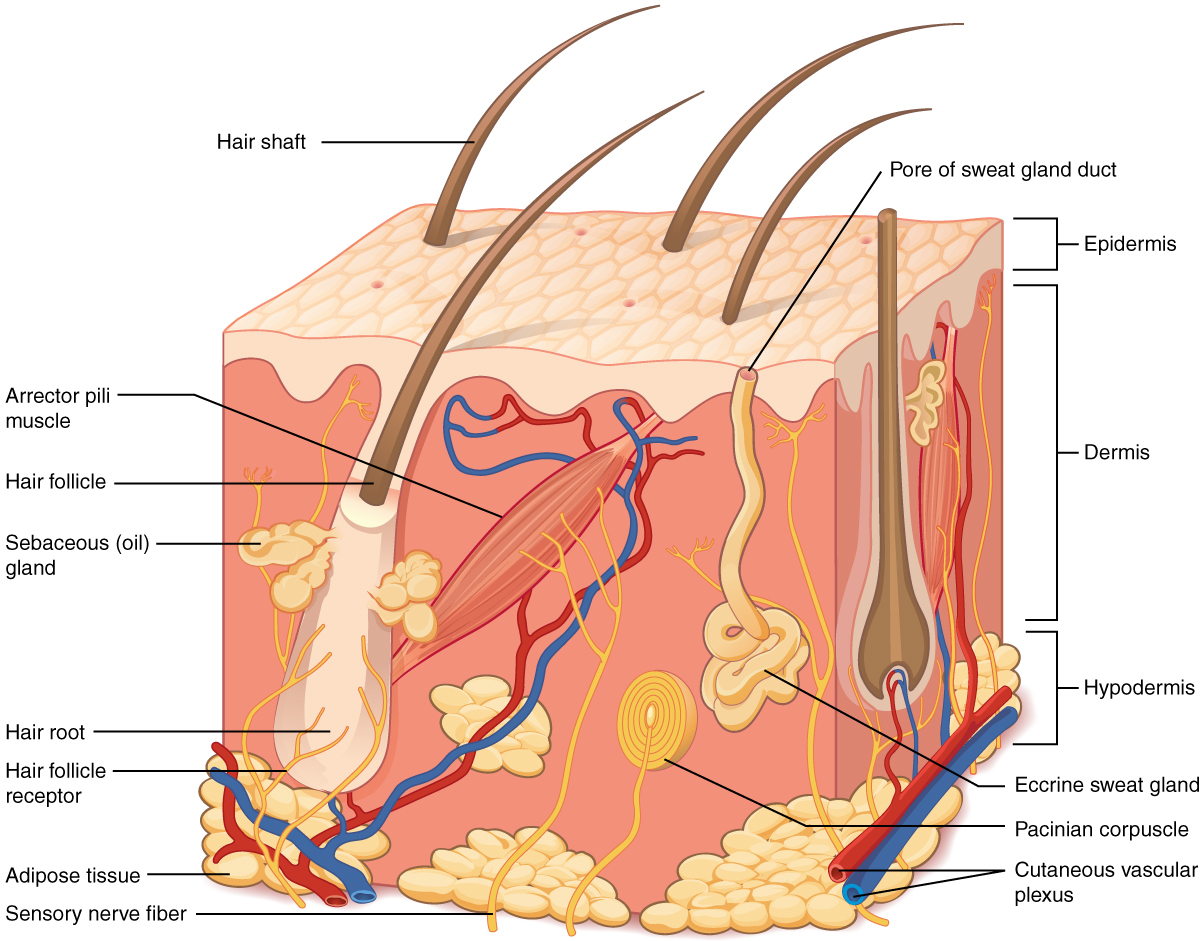
Skin contains several different structures. The dermis lies below the epidermis and above the fatty hypodermis. The sebaceous (oil) gland beside a follicle differs from the coiled eccrine sweat gland. This is a general anatomy diagram, not evidence that skin Botox reliably reduces every pore or gland function. It does not specify injection depth. OpenStax College, source image, CC BY 3.0. Labels and artwork unchanged. View full-size image.
4. How does salivary gland Botox affect the jawline?
Salivary glands receive autonomic nerve signals that stimulate secretion. Reducing acetylcholine release can reduce saliva output. This does not work by blocking a salivary duct or dissolving fat inside the gland.
The parotid glands sit around the area in front of and below the ears. The submandibular glands lie beneath the lower jaw. When a genuinely enlarged gland contributes to fullness, treatment may reduce its size and change the outline of that region. This is a different target from the masseter muscle.
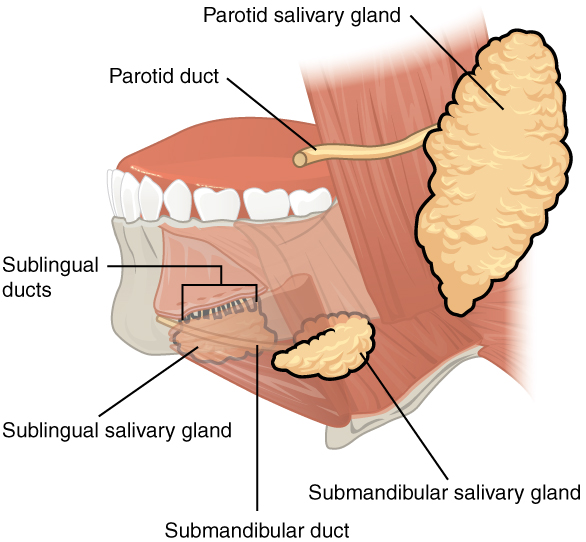
Three gland groups, different locations. The parotid sits near the ear, the submandibular gland beneath the jaw, and the sublingual gland beneath the tongue. Their ducts carry saliva into the mouth. A fullness near the jaw may arise from a gland rather than the masseter; examination is needed to distinguish them. OpenStax College, source image, CC BY 3.0. Labels and artwork unchanged. View full-size image.
Drooling treatment and cosmetic contouring ask different questions
The SIAXI trial randomised 184 adults with neurological conditions and chronic drooling to incobotulinumtoxinA or placebo. The higher-dose group showed significant improvement in salivary flow and patient-rated change at week 4, with benefit observed to week 16. Dry mouth and swallowing difficulty were among treatment-related adverse events. This is evidence about drooling, not proof of cosmetic jaw slimming in healthy travellers. SIAXI trial.
For cosmetic enlargement, a prospective parotid study enrolled 36 people, with 33 completing six months of follow-up. It reported reduced gland thickness and improved photographic contour, without a significant change in gland length. It was a small study without a placebo comparison. Parotid study abstract.
A separate report described 23 patients treated for benign enlargement of both submandibular glands. Its uncontrolled case-series design limits how confidently we can predict results or uncommon harms. Submandibular report abstract.
These observations support possible size reduction in enlarged glands. They do not establish that the tissue changes are identical to muscle atrophy. Nor does every bulge beneath the jaw represent an enlarged gland.
5. How do the treatments compare?
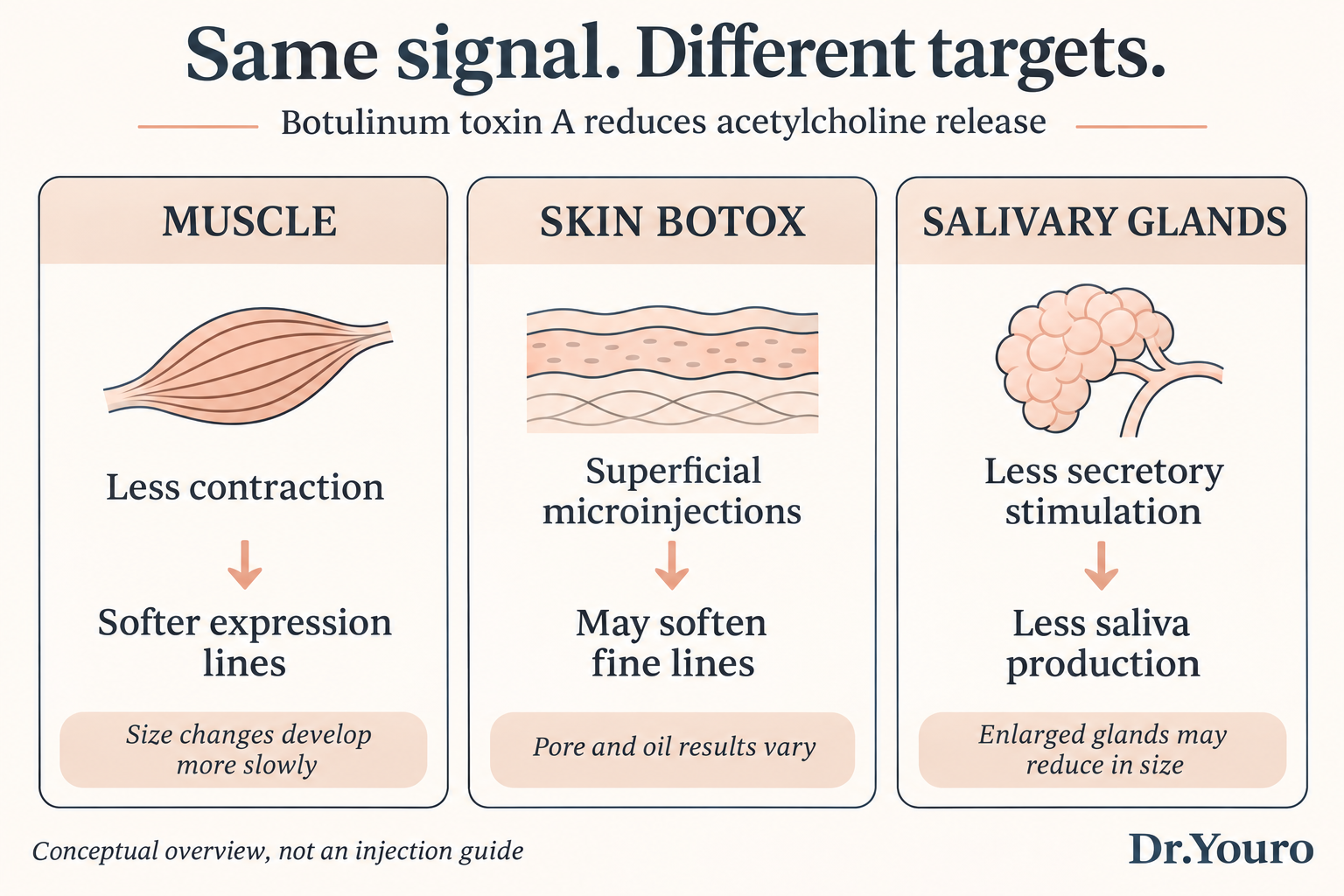
Conceptual overview. The target tissue determines the intended effect.
| Target | Main goal | Key distinction |
|---|---|---|
| Expression muscles | Softer movement lines | Less skin folding |
| Prominent muscles | Reduced bulk | Size changes gradually |
| Skin Botox | Fine lines and texture | Pore and oil results vary |
| Salivary glands | Reduced secretion, possible size reduction | Assess gland enlargement first |
6. What should visitors to Korea ask?
For visitors from the UK, US and other English-speaking countries, a package name alone does not explain what will be treated. Before booking, ask:
- What is causing my concern? Muscle, gland, fat and loose skin require different assessments.
- Which product and treatment are proposed? Ask about local approval and whether this use is off-label. Familiar branding does not establish approval for every indication or country.
- Who will assess and inject? Confirm the clinician’s qualifications and whether consultation, consent and aftercare are available in a language you understand.
- What does the quote include? Request the product, treatment areas, planned units, follow-up and additional charges in writing.
- When will we review the result? Give your departure date and arrange how progress will be assessed after you return home.
Keep a record of the date, product, areas and doses, plus a contact route for problems. Visible recovery, onset of action and the final contour result are separate issues. A short stay may end before a meaningful contour review is possible.
Discuss flights and planned activities with the treating clinician in the context of your health and treatment. There is no single travel timetable that suits every procedure and patient.
7. Why are the effects temporary, and what risks matter?
As toxin activity wanes and nerve signalling recovers, effects gradually fade. Recovery of signalling and tissue size need not happen at the same pace. Duration varies with the product, area, dose and individual response.
The function being reduced helps explain the risks: chewing weakness after masseter treatment, unwanted expression changes after facial treatment, and dry mouth or swallowing difficulty after gland treatment. Bruising, tenderness and swelling can also occur. Tell the clinician about previous injections, medicines, neuromuscular conditions and existing swallowing or breathing problems.
Seek urgent medical care for new difficulty breathing, swallowing or speaking after treatment. Do not wait for a routine review or an overseas clinic reply. Official safety information.
Frequently asked questions
Does Botox dissolve muscle or fat?
No. Reduced nerve signalling can reduce muscle activity, followed by gradual changes in muscle size. It does not directly dissolve fat.
Is skin Botox a different medicine?
It describes a treatment approach, not a separate drug category. Product, concentration, depth and distribution can vary.
Will gland Botox give me a sharper jawline?
It may help when benign gland enlargement contributes to fullness. It cannot be expected to produce the same result when fat, bone, muscle or loose skin is the main cause.
Should I have all three during one trip?
There is no reason to treat all three simply because they appear on a menu. Start with your concern, examination findings and a realistic follow-up plan.
Which tissue are we treating, and which function are we trying to reduce? Starting with that question makes the expected benefit and trade-offs easier to understand.
Your own, Dr. Youro
References and reading
Molecular figures: Choudhury S, Baker MR, Chatterjee S, Kumar H. Botulinum Toxin: An Update on Pharmacology and Newer Products in Development. Toxins. 2021;13(1):58. doi:10.3390/toxins13010058. Sections 2–3 and Figures 1–2 reviewed. Anatomy plates: OpenStax, Anatomy & Physiology, with the source edition and reuse licence linked beneath each image.
The two cosmetic gland reports were checked at abstract level; the skin study and correction, SIAXI report and official label were checked in their available full text. The masseter finding was checked in its accessible study summary.
- AbbVie. BOTOX Cosmetic US prescribing information, revised October 2024. Official label.
- A Controlled Phase 2b Trial to Assess the Efficacy and Safety of a Single Intervention of OnabotulinumtoxinA for Treating Masseter Muscle Prominence. Aesthetic Surgery Journal. 2025;45(10):1043-1050. doi:10.1093/asj/sjaf042. PMC record.
- Shin DM, et al. A Double-Blind, Split-Face, Randomized Study on the Effects and Safety of Intradermal Injection of Botulinum Toxin Type A 150 kD Neurotoxin in the Cheek. Ann Dermatol. 2022;34(6):442-450. doi:10.5021/ad.21.316. Product terminology corrected in 2023;35(1):88. Correction.
- Jost WH, et al. SIAXI: Placebo-controlled, randomized, double-blind study of incobotulinumtoxinA for sialorrhea. Neurology. 2019;92(17):e1982-e1991. DOI.
- Chen Z, et al. Efficacy and Safety of Botulinum Toxin Type A in the Treatment of Benign Parotid Hypertrophy: A Prospective Study. Plast Reconstr Surg. 2022;150(5):979e-986e. PMID:35994355.
- Karapantzou C, Jakob M, Canis M. Neurotoxin injection in benign submandibular gland hypertrophy: A first choice treatment. Laryngoscope Investig Otolaryngol. 2020;5(2):217-220. DOI.
Adapted for English-speaking readers from my Korean article on muscle, skin and salivary gland Botox.


Leave a Reply